
What Is a Columnar Database?

A columnar database stores values from the same column together within data blocks or segments. When a query needs selected columns, the engine can skip storage blocks containing unrelated column data. This layout can reduce data reads and improve compression for analytical queries that scan and aggregate many records.
Columnar databases are also known as column-oriented databases or column-store databases. The term columnar data describes values organized by attribute rather than as complete records.
These databases commonly support analytical workloads such as business intelligence (BI), reporting, and the analytical processing that an OLAP database processes. Row-oriented storage often fits applications that read or update complete records, although performance depends on the database implementation and workload.
How Does a Columnar Database Store Data?
A columnar database groups values from the same column into storage units such as blocks or segments. The table still presents data logically as rows and columns, while its storage orientation determines how values are arranged physically.
Row-oriented storage keeps the values for one record together. Consider this simplified table:
| Order ID | Region | Product | Revenue |
|---|---|---|---|
| 101 | West | Software | 1200 |
| 102 | East | Services | 850 |
| 103 | West | Support | 600 |
The two storage layouts organize these values differently.
Row-oriented storage
[101, West, Software, 1,200]
[102, East, Services, 850]
[103, West, Support, 600]
Columnar storage
Order ID: [101, 102, 103]
Region: [West, East, West]
Product: [Software, Services, Support]
Revenue: [1,200, 850, 600]
Columnar databases use implementation-specific storage units rather than one universal physical format. Depending on the implementation, these units can include blocks, segments, data parts, or micro-partitions. The database preserves the information needed to associate values from different columns with the same logical record.
When a query needs only Region and Revenue, a columnar database can skip the corresponding Order ID and Product data. Grouping values with the same data type can also support compression methods tailored to those values.
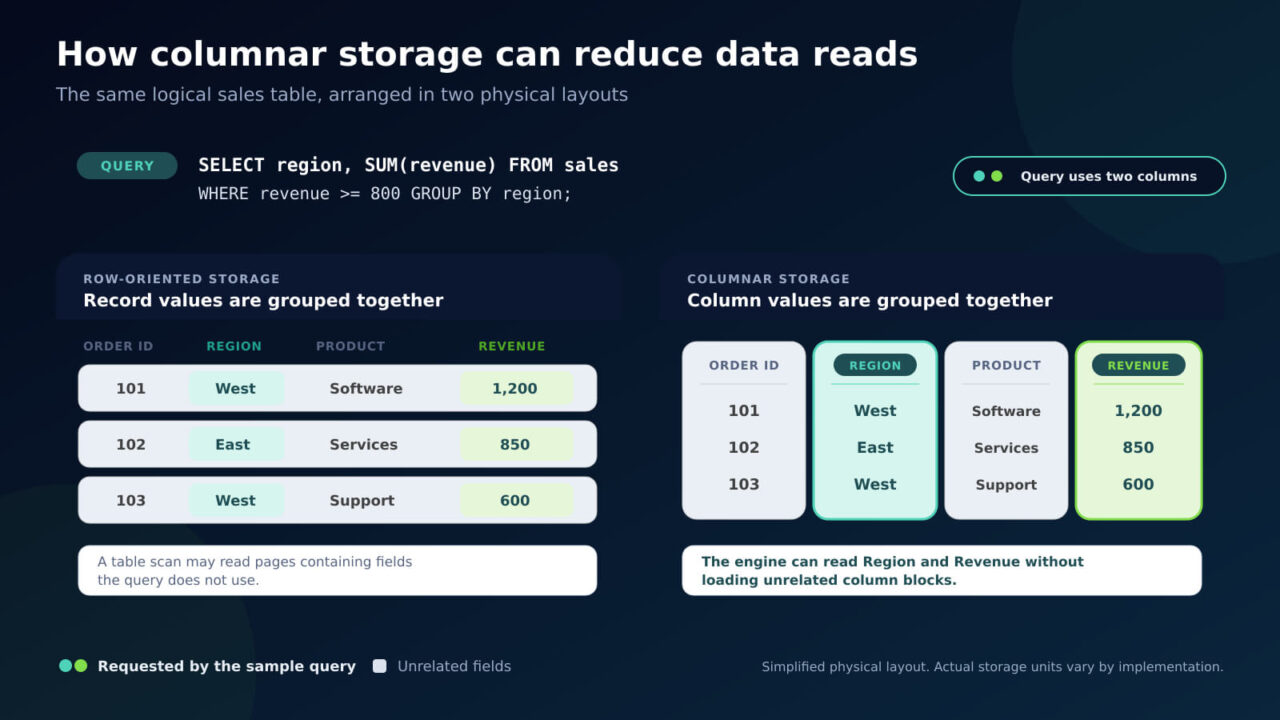
This storage orientation defines how the database organizes data physically. Our columnar vs row database guide compares both storage layouts in detail.
How Does a Columnar Database Process a Query?
A columnar database processes a query by identifying the required columns and locating the relevant storage units. It then reads the selected data and applies filters, aggregations, joins, or other operations defined by the query. The exact process depends on the database implementation and execution plan.
Consider this query:
SELECT region, SUM(revenue) AS total_revenue
FROM sales
WHERE revenue >= 800
GROUP BY region;
With the sample data, the result contains East with total_revenue of 850 and West with total_revenue of 1,200. The record with revenue of 600 does not meet the WHERE condition and is excluded.
The query references only the region and revenue columns. A columnar database can process the query through the following stages:
- Parse and plan the query. The database validates the SQL and creates an execution plan for filtering and aggregation.
- Identify the required columns. The plan requests only
regionandrevenue. The storage engine can then avoid reading unrelated column data when its format supports selective access. - Check whether storage units can be pruned. Metadata may allow the database to skip blocks or segments whose maximum revenue value is below 800. This process depends on the available metadata and data organization.
- Read and decode the selected data. The database retrieves the relevant
regionandrevenuevalues and decompresses them when required. - Execute the operations. The engine applies the filter, groups the qualifying rows by region, calculates each revenue total, and returns the results.
Some systems distribute these query stages across multiple nodes. In an mpp database, the engine assigns parts of the execution plan to different nodes and combines their partial results.

Test Real Analytical Workloads with Exasol Personal
Unlimited data. Full analytics performance.
How Does Columnar Storage Improve Query Performance in Large Datasets?
Columnar storage can improve analytical query performance by reducing the data each operation must read and process. The main mechanisms include selective column access, compression, data skipping, efficient aggregation, and vectorized execution in some database engines.
Reading only the required columns
Analytical queries often reference a limited set of columns across many records. When the storage format supports selective access, the engine can avoid reading blocks containing unrelated column data. This can reduce storage reads, memory use, and data movement during wide-table scans.
Compressing similar values
Values within a column share a data type and may contain repeated patterns. Column-specific methods, including dictionary and run-length encoding, can reduce storage size and the amount of data transferred into memory. Some formats also use delta encoding, which stores differences between adjacent numeric values. Compression effectiveness depends on value distribution, storage order, encoding methods, and engine behavior.
Skipping irrelevant storage units
Some columnar formats store metadata, such as minimum and maximum values, for individual blocks or segments. The optimizer can use this metadata to skip storage units that cannot satisfy a query filter. This technique is often called data skipping or storage pruning. Depending on the storage layout, partition pruning and filter pushdown can further reduce unnecessary reads during analytical queries.
Pruning effectiveness depends on the available metadata, filter conditions, and physical data organization. A columnar layout does not guarantee that every query can skip data.
Processing filters and aggregations
Filters and aggregations can operate on selected column values without reconstructing every complete record. This access pattern supports operations such as SUM(), AVG(), COUNT(), and GROUP BY across large datasets.
The benefit depends on which columns the query references and how the engine executes the operation. Queries that retrieve most available columns may gain less from selective column access.
Using vectorized execution
Some columnar engines use vectorized execution to process batches of values through each query operator. This approach can reduce instruction overhead and use CPU vector capabilities when the implementation supports them.
Vectorized execution is separate from columnar storage, so not every columnar database uses it. Some row-oriented and hybrid systems can also implement vectorized processing.
Columnar storage alone does not guarantee faster queries. Performance also depends on query design, data organization, optimization, hardware, concurrency, and database implementation. An Exasol database benchmark of five analytical systems ran the same 22 TPC-H queries using matched data and instance types. Results varied across concurrency, data volume, and node configurations, illustrating why teams should test the complete workload.
These characteristics often suit an analytics database handling scan-heavy queries across large datasets.
Try Exasol Personal for Free
Run real workloads at full Exasol performance.
What Are the Limitations of a Columnar Database?
Potential limitations include smaller gains for complete-record queries and engine-specific overhead for updates and data maintenance. Update patterns, selected columns, compression, and data organization can affect performance differently across engines. These considerations require workload testing because storage orientation alone does not determine database performance.
Handling frequent data changes
Modern columnar databases can support inserts, updates, and deletes through engine-specific techniques. Some engines buffer changes in temporary storage or reorganize column segments in the background. Performance depends on change volume, batch size, and how the engine manages compressed data. Teams evaluating write-heavy or mixed workloads should test representative operations under realistic conditions.
Queries that retrieve complete records
Columnar storage often reduces data reads when queries reference only a subset of available columns. Queries that retrieve complete records may receive a smaller benefit from column pruning. An application retrieving one customer record may need values from many separate column segments. Indexes, caches, or hybrid storage layouts can support these query patterns in some systems.
Compression and background maintenance
Encoding adds processing during data loading. Some query paths must decode stored values before or during execution. In engines using segment metadata, sorted values can improve data pruning and compression. Depending on implementation, the engine may organize or merge data through background processes. These processes vary across products and should be assessed with representative workloads.
Storage orientation represents only one part of overall database design and performance. Representative database benchmarks across reads, writes, concurrency, and scale provides a more reliable basis for evaluation.
Are Columnar Databases Relational?
A columnar database can be relational because “columnar” and “relational” describe different database properties. The relational model organizes data as relations represented by tables, while columnar storage describes physical value organization. Many analytical columnar databases therefore combine relational schemas with column-oriented physical storage. This distinction helps classify types of databases without treating relational and columnar systems as direct alternatives.
In a relational columnar database, table schemas define columns, data types, keys, and other constraints. The engine stores values from each column together rather than placing complete rows together. Queries still operate on tables and return rows even when the underlying storage is column-oriented.
Storage orientation alone does not determine whether a database follows the relational model.
Do Columnar Databases Support SQL and ACID Transactions?
Columnar databases can support SQL and ACID transactions because storage orientation does not determine either capability. Specific SQL features, isolation levels, and transaction guarantees depend on the database engine.
SQL support
A relational columnar database can support SQL for selecting, joining, filtering, and aggregating data. Supported syntax, data types, constraints, window functions, and extensions vary across products. Teams should verify compatibility against existing queries, BI tools, and data pipelines.
ACID transactions
ACID refers to atomicity, consistency, isolation, and durability within database transactions. A columnar database is ACID compliant when its transaction engine enforces all four properties. A COMMIT makes a transaction’s changes permanent, while a ROLLBACK undoes its uncommitted changes.
Supported isolation levels, concurrent-write behavior, and recovery mechanisms remain specific to each engine. Teams requiring frequent concurrent writes should test transaction semantics and throughput with representative workloads.
How Do Columnar Databases Relate to Other Data Technologies?
Columnar storage, columnar file formats, in-memory processing, and MPP execution describe different database architecture properties. A columnar database can use several of these technologies, but the terms are not interchangeable.
| Technology | What it describes | Relationship to a columnar database |
|---|---|---|
| Columnar storage | How an engine physically groups values from the same column within data blocks or segments. | This is the storage orientation used by a columnar database. |
| Columnar file format | How data is represented in files such as Apache Parquet and Apache ORC. | A database or query engine can read or write these formats. The format doesn’t independently provide database services. |
| In-memory database | How a database uses main memory as the primary location for storing and processing active data. | A database can combine in-memory processing with columnar storage. |
| MPP database | How a database distributes query work across multiple nodes for parallel processing. | The same database can combine MPP execution with columnar storage. |
These architectural properties can coexist within one database system. An in memory database can also use columnar storage and distribute query processing across multiple nodes.
What Is the Difference Between a Columnar Database and a Wide-Column Database?
An analytical columnar database stores values from the same table column together. This layout can support selective column reads, compression, scans, and aggregations across many records.
Wide-column systems organize flexible fields around row keys and group related columns into column families. Columnar analytical systems instead store values from the same attribute together across multiple records.
Apache Cassandra and Apache HBase are established examples of wide-column database systems. Their data models differ from the relational column-store model used by many analytical columnar databases.
What Are the Common Use Cases for Column-Oriented Databases in Industry?
Column-oriented databases commonly support data warehousing, business intelligence, reporting, dashboards, customer analysis, and high-volume event analysis. These workloads often scan many records while filtering or aggregating selected columns. The suitability of columnar storage depends on the query pattern, ingestion requirements, latency targets, concurrency, and database implementation.
| Industry or use case | Typical data and query pattern | Why columnar storage may fit |
|---|---|---|
| Business intelligence and reporting | Recurring reports query measures and dimensions across large fact tables. | Queries can read selected metrics and dimensions without retrieving unrelated column data. |
| Data warehousing and historical analysis | Analysts filter, join, and aggregate large datasets across extended time periods. | Selective column access, compression, and storage pruning can reduce data processed during analytical scans. |
| Retail and ecommerce analytics | Teams analyze sales, products, inventory, transactions, and customer activity. | Queries often aggregate selected attributes across large transaction and event datasets. |
| Financial services analytics | Workloads include portfolio analysis, historical risk calculations, financial reporting, and regulatory reporting. | These workloads frequently calculate measures across large historical datasets using defined dimensions and time periods. |
| Product and customer analytics | Teams analyze application events, feature usage, funnels, cohorts, and customer behavior. | Event datasets often contain many attributes, while individual queries reference only a limited subset. |
| Telecommunications and IoT analytics | Systems analyze usage records, network events, device measurements, and sensor data. | Queries commonly filter large event volumes by time, device, location, or selected measurements. |
| Log and observability analytics | Teams search logs, metrics, and other operational events across defined time ranges. | Columnar storage can reduce reads when queries select and aggregate specific fields from wide event records. |
| Real-time analytics and dashboards | Dashboards query recently ingested events using filters, groupings, and aggregations. | Selective reads and aggregation can support these queries, although ingestion speed and latency depend on the database engine. |
These use cases share a common access pattern: queries examine many records while using a limited set of columns. A real-time analytics database, for example, can apply this pattern to recently ingested events. Columnar storage may provide smaller gains when applications primarily retrieve complete records by key or require frequent low-latency row changes.
Storage orientation alone does not determine concurrency, ingestion performance, transaction behavior, or operational reliability. Teams should evaluate these capabilities using representative data, queries, write patterns, and concurrent workloads.
Try Exasol Personal for Free
Run real workloads at full Exasol performance.
Frequently asked questions
Standard MySQL with InnoDB is row-oriented. Its clustered index stores row data together, which supports transactional access patterns. MySQL HeatWave adds an in-memory accelerator that stores loaded data in a hybrid-columnar format for analytical processing.
Apache Cassandra is a distributed NoSQL database with a partitioned wide-column storage model. This model uses partition keys for key-oriented access and differs from analytical column stores designed for column scans and aggregations.
No single columnar database is best for every workload. Popular examples include Amazon Redshift, Exasol, and Snowflake. Evaluate candidates using representative data, queries, concurrency, latency targets, deployment requirements, SQL compatibility, and total cost of ownership.