
What Is a Relational Database? Advantages, Structure, and Use Cases

A relational database organizes data into tables of rows and columns. Each row represents a record, with columns holding its attribute values. Primary keys identify records, while foreign keys express references to related records.
A relational database management system (RDBMS) is the software used to create and manage these databases. SQL is a language commonly used to define their structure, retrieve records, and change data.
Relational describes the logical data model. A relational database can serve transactional or analytical workloads and use row-oriented or columnar storage. Evaluating its benefits means checking how its schema and engine fit the workload.
Advantages and Benefits of a Relational Database
The main advantages of a relational database include integrity checks, flexible querying, and more manageable updates. These benefits depend on schema design, enforced rules, and the database engine’s capabilities.
| Benefit | Supporting mechanism | Condition to check |
|---|---|---|
| Consistent identifiers and references | Primary-key and foreign-key constraints | The required constraints are supported, correctly defined, and enforced. |
| Coordinated changes | Transactions group related operations | Transaction boundaries and application error handling match the business operation. |
| Flexible querying | SQL joins, filters, and aggregations | Queries use the intended relationships and count records correctly. |
| Controlled redundancy | Normalization separates facts according to their dependencies | The design distinguishes current attributes from historical facts and manages intentional duplication. |
How do relational databases handle data integrity and security?
Relational databases support integrity through constraints and transaction management. Enforced primary-key constraints require unique, non-null identifiers, while enforced foreign-key constraints check references to related records. These checks enforce the rules defined in the schema; they cannot establish whether every accepted value is factually correct.
Constraint enforcement requires attention. Exasol, for example, allows primary-key and foreign-key constraints to be enabled or disabled. Declaring a relationship does not necessarily mean the database checks it.
Transactions let applications group related changes so they commit or roll back together. Applications still need appropriate transaction boundaries and error handling, including a response to transaction conflicts.
Security requires additional controls. Authentication verifies identity, while permissions determine which operations a user or application can perform. Secure connections and deployment configuration also matter. The relational model alone does not provide these protections.

Try Exasol Personal for Free
Run real workloads at full Exasol performance.
Flexible querying across related data
SQL lets users combine related records, filter results, and calculate aggregates without creating a separate stored dataset for every question. This flexibility supports different queries over the same underlying facts.
In an illustrative accounts-and-subscriptions model, a team could identify accounts with active subscriptions or count active subscriptions per account. Both questions use the same relationships, with different selections and aggregations.
Correct results depend on the query logic. A join can produce several rows for one account, so counting joined rows may count subscriptions rather than accounts. Query performance also depends on the engine, data distribution, and execution plan.
Controlled redundancy and maintainable data
Normalization organizes tables around data dependencies to reduce unnecessary repetition and update inconsistencies. If an account has one current contact address, storing it in the account record avoids maintaining copies in every subscription.
Historical facts need different treatment. An agreed subscription price may need to remain unchanged when the current plan price changes. Removing that stored price could erase information needed to interpret earlier transactions. For attributes that change over time, preserving earlier values requires an explicit model of their history.
Decisions about normalization vs denormalization should reflect update patterns and query requirements. Intentional duplication can simplify some reads, but repeated current attributes then need a reliable update process.
How Does a Relational Database Work
A relational database separates the logical structure of data from its physical storage. Applications query tables and relationships, while the database engine determines how to access and process the data.
Tables, rows, columns, and schemas
Each table needs a defined row meaning, such as one account, one subscription, or one invoice. Columns describe attributes of those records, with data types specifying how the database represents their values. In relational terminology, rows are tuples and columns represent attributes.
The database schema specifies tables, columns, data types, keys, and constraints. Some SQL systems also use “schema” for a namespace grouping tables and other database objects.
Base tables hold stored records. Application forms can provide interfaces for entering or retrieving records.
SQL tables can contain duplicate rows unless suitable constraints prevent them. DISTINCT removes duplicate result rows, while ORDER BY specifies result ordering.
Why do relational databases use primary keys and foreign keys
Primary keys establish record identity, while foreign keys declare references between records. Together, they make relationships explicit and support integrity checks when the database enforces the constraints.
A primary key can contain one column or several columns. For a composite primary key, the combination must be unique, even when individual column values repeat. A column that happens to contain unique values in a small sample is not necessarily a suitable key.
A foreign key references an eligible key in the referenced table. Eligibility rules vary by engine; Exasol foreign keys reference primary keys.
In a one-to-many relationship, one account can have several subscriptions. Each subscription stores the identifier of its account. Whether that reference is required depends on the column’s nullability and the defined constraints.
A foreign-key constraint and a join perform different jobs. The constraint checks permitted references when enforced; the join combines rows according to a query condition. SQL can join tables without a declared foreign key.
How can the data in a relational database be accessed
Applications and users commonly access relational data through SQL statements. SELECT retrieves records, while INSERT, UPDATE, and DELETE change stored data, subject to permissions and enforced constraints.
A query can select particular columns, filter records, combine tables, and aggregate results. For example, counting active subscriptions per account requires matching account identifiers, selecting active subscriptions, and grouping the results by account.
SQL describes the required result rather than prescribing every physical access step. The database engine determines how to execute the request. The logical order of query clauses helps explain how filtering and grouping affect the result.
The SQL schema example illustrates table definitions and constraint inspection in Exasol. The following example focuses on how related records answer a business question.
What are some common examples of relational data in real-world applications?
Accounts and subscriptions provide one example of related business data. Exasol is an example of database software that manages relational data; the tables below illustrate the data model itself.
This synthetic dataset uses two tables. Each account row represents one account, and each subscription row represents one subscription. Assume both primary keys are enforced. The subscriptions.account_id column is NOT NULL, with an enforced foreign key referencing accounts.account_id.
Accounts:
| account_id | account_name |
|---|---|
| 101 | Account A |
| 102 | Account B |
Subscriptions:
| subscription_id | account_id | status |
|---|---|---|
| 1001 | 101 | active |
| 1002 | 101 | active |
| 1003 | 102 | cancelled |
The relationship permits an account to have zero or more subscriptions. Each subscription must reference exactly one account in this design.
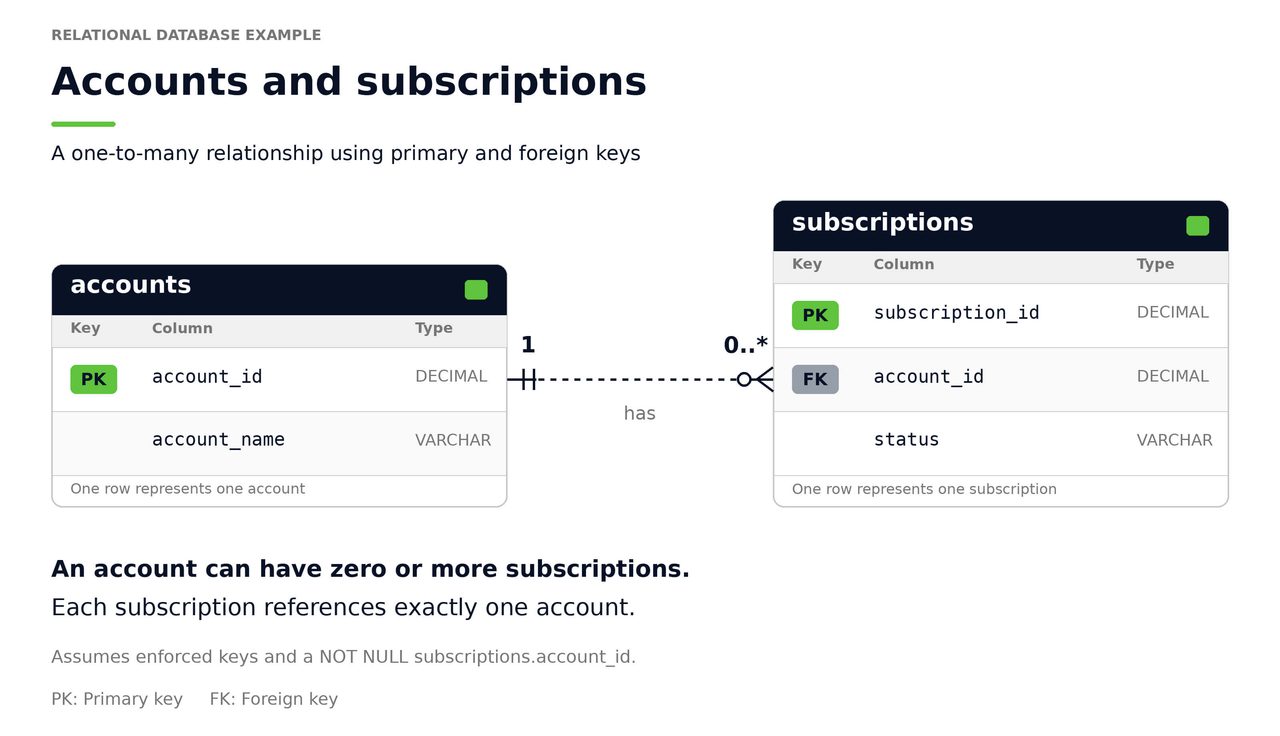
The model stores each account’s current name in its account record. Subscriptions reference that record through account_id, so changing the name does not require updating a copy in every subscription.
Now the question: How many active subscriptions does each account have, including accounts with none?
The following illustrative Exasol SQL assumes both tables are available in the current schema. The query has not been executed; make sure you test it in your environment.
SELECT
    a.account_id,
    a.account_name,
    COUNT(s.subscription_id) AS active_subscriptions
FROM accounts a
LEFT JOIN subscriptions s
    ON s.account_id = a.account_id
   AND s.status = 'active'
GROUP BY
    a.account_id,
    a.account_name
ORDER BY
    a.account_id;
Expected result for the rows above:
| ACCOUNT_ID | ACCOUNT_NAME | ACTIVE_SUBSCRIPTIONS |
|---|---|---|
| 101 | Account A | 2 |
| 102 | Account B | 0 |
The LEFT JOIN preserves accounts without matching active subscriptions. Keeping the status condition in ON allows Account B to remain in the result.
COUNT(s.subscription_id) counts non-null subscription identifiers, producing zero where no active subscription matches. Each result row represents one account, while the aggregate counts its active subscriptions.
Customers and orders follow a similar pattern: one customer can have several orders, with each order referencing its customer. The appropriate tables and constraints depend on what each record represents and which relationships the application requires.
Limitations and Tradeoffs of Relational Databases
The main tradeoffs involve modeling effort, schema changes, query complexity, and the work needed to enforce integrity. Their impact depends on the database engine and workload.
Schema design requires decisions about record identity, relationships, data types, and business rules. Later changes can affect application code, data pipelines, and reporting queries. Renaming a column calls for checking the queries and applications that reference it.
The database checks declared constraints according to their definitions and enforcement settings. In the subscription example, a valid account reference doesn’t establish whether a subscription should be active. Validating that status requires the relevant business rules and logic.
Normalized designs can require queries to join several tables to assemble the requested information. Denormalization may simplify selected reads by duplicating data or precombining related records. Repeated current values need a consistent refresh process. Compare that maintenance cost with the measured query benefit.
Constraint checking and transaction coordination add processing work. Depending on the engine and isolation level, competing transactions may wait or roll back when conflicts occur. Applications need to handle those outcomes according to the engine’s transaction semantics.
Performance and scalability depend on the engine, storage layout, data distribution, concurrency, and operational design. Assess the selected system against representative data volumes, query patterns, and latency requirements. A relational data model alone doesn’t establish how well a particular engine will serve those requirements.
Try Exasol Personal for Free
Run real workloads at full Exasol performance.
When Should You Use a Relational Database?
Consider a relational database when explicit relationships and SQL queries across related records are central to your application. Evaluate a specific engine against the required integrity rules, read/write patterns, and service targets.
In the subscription scenario, operational requests could create accounts, add subscriptions, or change subscription status. Analytical requests could count active subscriptions by account or, with additional metering records, summarize consumption over time.
Separate data model from workload and storage
Relational, columnar, distributed, and in-memory describe different properties that can coexist in one system. Understanding how columnar databases work helps distinguish column-oriented storage from the logical tables exposed to queries.
Transaction guarantees also need separate evaluation from workload orientation. An engine’s ACID guarantees don’t establish its suitability for frequent record-level changes. The transactional vs relational databases comparison explains how these properties overlap.
Relational tables can also form part of a data warehouse. Its analytical purpose is a separate consideration from the data model used within it.
Match requirements to a database engine
Translate the application’s requirements into checks for a particular engine. Use the following criteria to evaluate model fit and the evidence needed for selection.
| Requirement | Relevance of the relational model | Evidence to gather |
|---|---|---|
| Related business records and integrity rules | Primary keys identify records; foreign keys express references between them. | Supported constraints, enforcement settings, nullability, and behavior for invalid references. |
| Frequent operational changes | Shared identifiers connect the records involved in a business operation. | Transaction boundaries, isolation, rollback behavior, and latency under representative concurrent writes. |
| Reporting across related records | SQL expresses joins, filters, and aggregations. | Query plans and response times with representative data volumes and concurrent reporting demand. |
| Freshness and changing inputs | The relational model alone doesn’t determine data freshness. | Source-to-query delay, refresh processes, and compatibility of schema changes with applications and pipelines. |
| Deployment and operations | The logical model leaves deployment choices open. | Supported environments, recovery procedures, upgrade processes, monitoring, and operating skills. |
The database design principles connect schema choices to access patterns, constraint strategy, and planned schema evolution. Document those choices alongside the service requirements used to evaluate the engine.
When reporting and operational changes share a system, include both in the evaluation. If you separate them, include the data pipeline’s freshness and operational costs.
Exasol as a Relational Database for Analytics
The Exasol database combines relational tables and SQL with capabilities for business intelligence and AI workloads. Its analytical role includes high-concurrency BI, where multiple users and applications query data simultaneously.
Exasol can also act as an analytics acceleration layer between existing data sources and BI tools. In-memory processing and parallel query execution support this role. Evaluate response times with representative queries and concurrent demand to establish the benefit for your workload.
For AI workloads, user-defined functions and Script Language Containers support running machine learning models inside the database. The Exasol Model Context Protocol (MCP) Server connects AI assistants to the database, providing another interface for working with relational data.
Deployment choices also matter for data sovereignty. Exasol offers on-premises, hybrid, and cloud options, allowing teams to select an environment suited to their requirements. Evaluate where data resides, who can access it, and where connected AI models process it. Sovereignty depends on the complete deployment and its controls.
For hands-on exploration, the Exasol Personal Starter Kit bundles a local Exasol database, an MCP server, the exapump data-loading tool, and the pyexasol Python driver. Exasol Personal is free for personal, single-user use. You can use this environment to explore table relationships, test SQL queries, and experiment with AI-assisted database access.
Frequently Asked Questions
SQL is a language for defining, querying, and modifying data. A relational database organizes data into tables according to the relational model. An RDBMS provides the software that manages the database and executes SQL statements.
No. SQL stands for Structured Query Language. It is a language used by database systems, including Exasol. Microsoft SQL Server is a database management system; SQL itself is the language.
Examples of relational database systems include Exasol, MySQL, PostgreSQL, Microsoft SQL Server, and Oracle Database. A business database containing related accounts, subscriptions, and invoices illustrates how relational data can be organized.
“Top” depends on the selection criteria, including workload, performance requirements, deployment options, and cost. Exasol, MySQL, PostgreSQL, Microsoft SQL Server, and Oracle Database are five examples to evaluate. (This is an illustrative list, rather than a ranking.)
A database is an organized collection of data. A relational database is a specific type that organizes data into tables of rows and columns. Other database models organize data as documents, key-value pairs, or graphs.
Five database categories based on their data models are:
- Relational: Exasol.
- Document: MongoDB.
- Key-value: Redis.
- Graph: Neo4j.
- Wide-column: Apache Cassandra.
This classification is not exhaustive, and individual systems can support multiple models. Wide-column databases and columnar storage in relational databases describe different concepts.