
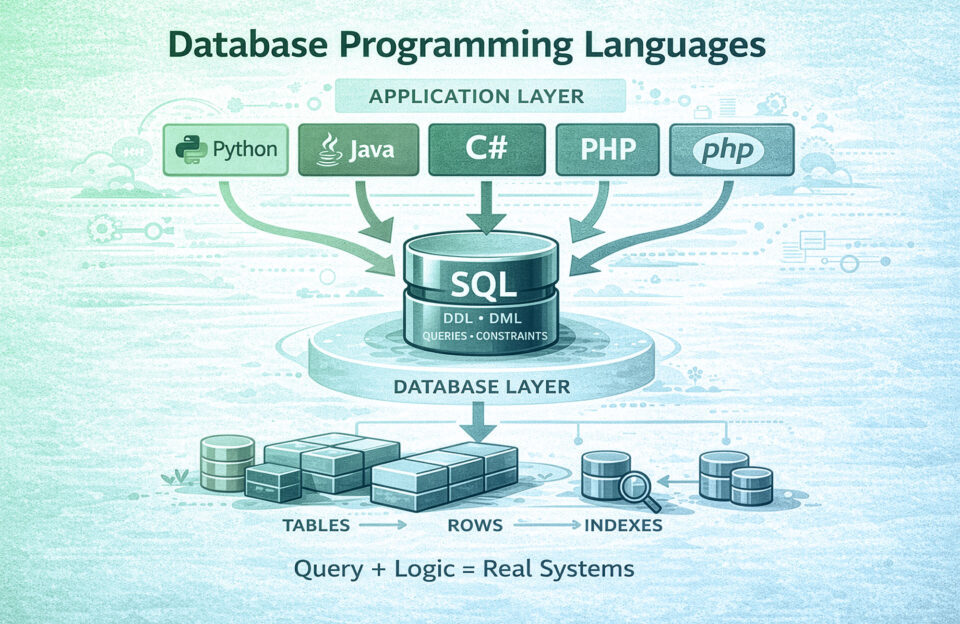
Database Programming Languages

Database programming languages are used to define database structures, query stored data, modify records, and control access within database systems. The most widely used example is SQL, which interacts with relational databases through queries that retrieve and update structured data.
These languages define how applications interact with stored data. In relational systems, SQL defines tables, retrieves records, and enforces constraints. In practice, database programming also involves general-purpose languages such as Python, Java, C#, or PHP, which send queries and process results in application workflows.
Database environments typically combine these layers. The database handles storage and query execution, while the application layer manages logic, user interaction, and system integration. This structure is used across web applications, analytics pipelines, and enterprise systems, including high-performance analytical platforms such as the Analytics Engine.
Most databases organize information in structured tables made of rows and columns, a structure covered in foundational database concepts. Developers use it to create tables, retrieve specific records, update stored values, and remove outdated data.
Database languages are designed specifically for working with structured data. Unlike general-purpose programming languages, which control application logic, a database programming language focuses on data definition, data retrieval, and data manipulation inside the database system.
For this reason, database programming usually combines two layers:
- a database language that interacts with stored data
- an application language that runs the software using that data
This separation allows database systems to manage large volumes of structured information efficiently while applications control how that information is used.
In practice, most systems do not rely on a single database language. Instead, they combine query languages with application-level code to manage data workflows at scale.
Dirk Beerbohm, Global Partner Solution Architect, Exasol

Test Real Analytical Workloads with Exasol Personal
Unlimited data. Full analytics performance.
Common Database Programming Languages
Database environments typically combine two layers: a query language such as SQL that runs against the database, and an application language that sends queries and processes the results.
The most widely used database language is SQL, but database environments often involve additional languages that extend database functionality or connect applications to database systems.
SQL (Structured Query Language)
SQL is the primary language used in relational databases. It allows developers to define database structures, retrieve stored data, and modify records inside database tables.
Relational databases store information in structured tables composed of rows and columns. SQL provides the commands needed to interact with that structure. Developers use SQL queries to retrieve records, filter results, update stored data, and enforce rules that maintain consistency across the database.
Most relational database systems support SQL, including platforms such as PostgreSQL, MySQL, Oracle Database, and Microsoft SQL Server. Because of this broad adoption, SQL is the foundation of most database programming workflows.
SQL queries are processed by the database engine, which determines how to execute each request efficiently. The query processor analyzes the statement, builds an execution plan, and retrieves the required data from storage using indexes and optimized access paths.
PL/SQL
PL/SQL is a procedural extension of SQL used primarily in Oracle database environments. It allows developers to write stored procedures, functions, and database-side logic that executes inside the database server.
While SQL focuses on querying and modifying data, PL/SQL introduces programming features such as conditional logic, loops, and variables. These capabilities allow complex operations to run directly within the database rather than in the application layer.
T-SQL
T-SQL (Transact-SQL) is the procedural extension of SQL used in Microsoft SQL Server and Azure SQL environments. Like PL/SQL, it adds programming constructs that allow developers to build stored procedures and automated database routines.
T-SQL enables database logic such as transaction management, conditional execution, and error handling to run directly within the database system.
Python
Python is a general-purpose programming language widely used in data processing and analytics workflows. Although it does not operate inside a database system, Python is commonly used to connect applications to databases and process query results.
Applications written in Python interact with databases by sending SQL queries through database drivers or libraries. Python is often used in analytics pipelines, automation scripts, and data processing systems that rely on large datasets stored in databases.
Java
Java is frequently used in enterprise software systems that rely on relational databases. Many large applications connect Java services to databases using database connectivity frameworks.
In these systems, Java code sends SQL queries to the database, processes the returned data, and integrates database operations into application logic.
C#
C# is widely used in software systems built on the Microsoft technology stack. Applications written in C# commonly interact with SQL Server databases using database drivers and application frameworks.
C# applications retrieve data using SQL queries and integrate the returned information into user interfaces, services, and backend workflows.
PHP
PHP is commonly used in web applications that rely on relational databases. Many websites built with PHP connect to databases such as MySQL or PostgreSQL to store and retrieve application data.
In these systems, PHP scripts send SQL queries to the database and process the results to generate dynamic web pages or application responses.
In practice, database work combines specialized query languages with application-level programming. Database languages manage the structure and content of stored data, while application languages integrate that data into software systems.
Database Programming Languages vs General-Purpose Programming Languages
Database languages and general-purpose programming languages serve different roles in software systems. Both are used when working with databases, but they operate at different layers of an application architecture.
A database programming language interacts directly with the database system. It defines data structures, retrieves stored records, modifies existing data, and enforces rules that maintain consistency inside the database. SQL is the most common example of a database language used to perform these operations.
A general-purpose programming language, by contrast, controls the logic of an application. Languages such as Python, Java, C#, and PHP send queries to the database, process the returned results, and integrate database operations into larger software workflows.
In most applications, these two types of languages work together. The database manages data storage and query processing, while the application layer determines how that data is used.
Key Differences
| Aspect | Database Programming Languages | General-Purpose Programming Languages |
|---|---|---|
| Primary purpose | Retrieve, modify, and manage stored data | Implement application logic and workflows |
| Typical examples | SQL, PL/SQL, T-SQL | Python, Java, C#, PHP |
| Where the code runs | Inside or directly against the database system | In the application layer |
| Main operations | Queries, schema definition, data updates | APIs, business logic, automation |
| Interaction with data | Operate directly on database tables | Send queries and process returned results |
This separation isolates data processing in the database and application logic in the software layer. The database engine optimizes how data is stored and queried, while the application layer manages how users and services interact with that data.
In real-world systems, developers typically combine both approaches. SQL queries retrieve and update data, while application code processes that data and integrates it into web services, analytics pipelines, or enterprise applications.
Try Exasol Personal for Free
Run real workloads at full Exasol performance.
Is SQL a Database Programming Language?
Yes. SQL (Structured Query Language) is a specialized language designed to work with relational databases, one of several database types used to organize and process structured data. It allows developers to retrieve data, insert new records, update stored values, and define the structure of database tables.
Relational databases store information in tables composed of rows and columns. SQL defines how data is selected, filtered, and modified within relational tables.
For example, developers use SQL queries to retrieve specific records from a table or to update values stored in the database.
A simple SQL query might look like this:
SELECT customer_id, order_date
FROM orders
WHERE order_date >= '2026-01-01';
This query retrieves all orders placed after January 1, 2026 from the orders table. The database processes the query and returns the matching records.
SQL is considered a specialized database language because it focuses on operations performed directly on stored data. These operations typically fall into several categories:
- Data definition: creating or modifying tables and database structures
- Data manipulation: inserting, updating, and deleting records
- Data querying: retrieving filtered or aggregated data
- Access control: managing permissions and database users
Many database systems also support procedural extensions of SQL. Examples include PL/SQL used in Oracle environments and T-SQL used in Microsoft SQL Server. These extensions allow developers to write stored procedures, add conditional logic, and automate tasks directly inside the database.
Although SQL handles most database operations, it is usually combined with another programming language in real applications. Application languages send SQL queries to the database, process the returned data, and integrate database operations into larger software systems.
Types of Database Language Operations
Database languages are defined by the operations they perform inside a database system. These operations include defining structures, retrieving data, modifying records, and controlling access. In SQL, these operations are grouped into categories such as DDL, DML, and DQL.
Query Languages
Query languages handle one of the most common database operations: retrieving data. They allow developers to search for specific records, filter results, and combine data from multiple tables.
In relational databases, SQL queries retrieve data using commands such as SELECT. A query can filter results using conditions, sort records, or combine data from several tables through join operations.
Applications typically request only a subset of stored data, which queries retrieve using filters and conditions, such as orders placed within a particular time range or customers from a specific region.
Data Definition Languages (DDL)
Data Definition Languages define the structure of the database itself. These commands create and modify database objects such as tables, indexes, and constraints.
Examples of DDL operations include:
- creating a new table
- modifying an existing table
- defining relationships between tables
- creating indexes that improve query performance
In SQL, commands such as CREATE, ALTER, and DROPdefine how the database organizes its data.
DDL commands define the schema that controls how data is stored and related within the database.
Data Manipulation Languages (DML)
Data Manipulation Languages handle changes to records stored in database tables. These commands insert new data, update existing records, and remove outdated entries.
Common DML operations include:
- inserting new records
- updating existing rows
- deleting records that are no longer needed
In SQL, these actions are performed using commands such as INSERT, UPDATE, and DELETE.
DML operations keep stored data up to date by inserting, modifying, and deleting records.
Procedural Database Languages
Some database systems extend SQL with procedural capabilities. These languages allow developers to write logic that runs directly inside the database.
Procedural database languages support features such as:
- stored procedures
- conditional logic
- loops
- automated database tasks
Examples include PL/SQL used in Oracle databases and T-SQL used in Microsoft SQL Server.
Running logic inside the database reduces application overhead and improves performance for large data operations.
Languages Used with Databases
Database systems are typically accessed through general-purpose programming languages. These languages do not run inside the database itself but are used by applications that communicate with the database.
Examples include:
- Python
- Java
- C#
- PHP
Application code sends SQL queries to the database and processes the returned results within the application workflow.
Many frameworks also use object-relational mapping (ORM) layers to translate application objects into database queries. These components handle communication between the application and the database system, allowing developers to work with data without writing raw queries in every case.
Database Languages in Relational and Non-Relational Systems
Database programming languages are most commonly associated with relational databases, where SQL is used to query structured tables. However, not all database systems use the same model or query language.
Non-relational databases, often referred to as NoSQL databases, use different approaches to storing and retrieving data. These systems use different database models and may store information as documents, key-value pairs, or graphs rather than structured tables.
Examples include:
- Document databases, which store data in JSON-like formats and use query APIs or domain-specific query languages
- Graph databases, which represent relationships between data points and use query languages such as Cypher
- Key-value stores, which retrieve data using simple lookup operations
In these systems, developers often interact with the database through APIs or query interfaces rather than standard SQL. This means that database programming can involve different languages and query patterns depending on the database type.
Test Real Analytical Workloads with Exasol Personal
Unlimited data. Full analytics performance.
Database Programming in Practice
Database programming involves designing, managing, and interacting with databases in real systems. These tasks combine database languages such as SQL with application code that connects software to the database.
In most applications, database programming begins with designing the structure of the data. Developers define tables, relationships between tables, and constraints that ensure stored data remains consistent, although some systems use denormalized data to optimize read performance. These definitions form the database schema that determines how information is organized.
Once the schema is defined, developers write queries that allow applications to retrieve and modify stored data. These queries are responsible for tasks such as retrieving user accounts, recording transactions, or updating product inventories. Because applications rarely need all stored data, queries typically filter and combine records using conditions and joins.
Database programming also involves integrating the database with application logic. Application code sends queries to the database, receives the results, and uses that data to generate responses, reports, or user interfaces. This interaction is handled through database drivers, APIs, or application frameworks.
In addition to retrieving and updating data, database programming often includes tasks that maintain the performance and reliability of the system. Developers may create indexes to speed up queries, define stored procedures that automate repeated operations, and implement access controls that restrict who can read or modify data.
These activities define how applications store, retrieve, and manage structured data. Applications depend on databases to store large volumes of structured information, and database programming provides the mechanisms that allow software to access and manage that data efficiently.
Many database operations are executed within transactions, which ensure that multiple changes to the database are applied consistently. Transaction systems often follow ACID properties to maintain reliability and prevent data corruption during concurrent operations.
Examples of Tasks Database Programming Languages Support
Common database tasks include creating tables, retrieving filtered data, and maintaining consistency across datasets.
One common task is creating database tables that store structured information. Developers define tables with columns that represent different attributes of the data, such as customer names, order dates, or product prices. These definitions determine how data is organized and stored in the database.
Another frequent task is retrieving data through queries. Applications often need specific records rather than the entire contents of a database. A query can retrieve customer orders from the last month, identify products with low inventory, or calculate total sales for a particular region.
Database languages also support updating and maintaining stored data. Developers use commands to insert new records when information is created, update existing records when values change, and remove entries that are no longer needed. These operations keep the database aligned with the current state of the system.
In many systems, database programming languages also support joining data from multiple tables. Because relational databases store related data in separate tables, queries often combine records from several tables to produce meaningful results. For example, an order management system might join customer data with order records to generate a complete transaction history.
Other tasks supported by database programming languages include aggregating data and enforcing constraints. Aggregation functions can calculate totals, averages, or counts across large datasets. Constraints ensure that stored data follows specific rules, such as preventing duplicate entries or enforcing relationships between tables.
Together, these operations allow applications to read and modify data without directly managing how it is stored. The database system handles consistency, indexing, and query execution behind the scenes.
When Do You Need Another Programming Language Besides SQL?
SQL covers many core database tasks, particularly those that involve querying data, updating records, and defining database structures. However, most real-world systems require additional programming languages to manage application logic and coordinate interactions between users, services, and databases.
Application languages are responsible for tasks that extend beyond the capabilities of SQL. For example, a web application may use Python, Java, or C# to handle user authentication, process requests from a web interface, and generate responses that include data retrieved from a database. In this workflow, the application code sends SQL queries to the database and then processes the results.
Another reason to use an application language is automation and data processing. Many systems include scripts or services that regularly retrieve data, perform calculations, and store the results back in the database. These tasks are often implemented using general-purpose languages that can handle file processing, external APIs, and system-level operations.
Application languages are also used when databases are part of larger distributed systems. Microservices, analytics pipelines, and backend services typically retrieve data from databases and combine it with information from other systems. In these cases, SQL retrieves the data, while the application layer manages workflows, business rules, and communication between services.
The database handles data storage and query execution, while the application layer manages logic and user interaction.
How to Choose the Right Database Programming Language
Choosing a database programming language depends on the type of database system, the architecture of the application, and the tasks the system needs to perform. Most database environments use SQL as the core query language, but additional languages may be required depending on how the application interacts with the database.
In most systems, SQL is required for relational databases, but the choice of additional languages depends on how data is processed. Analytical workloads often rely on query-heavy systems, while application-driven systems depend more on integration with backend languages such as Java or Python.
Florian Wenzel, VP of Product, Exasol
One important factor is the type of database system being used. Relational databases rely heavily on SQL and its procedural extensions, while other systems may require different query or integration approaches. Understanding the underlying database architecture helps determine which languages are required for querying, automation, and application integration.
Another factor is the role of the database within the system. Some systems primarily store and retrieve transactional data, such as user accounts or purchase records. Others process large volumes of analytical data to support reporting or data analysis. Analytical systems often run complex queries across large datasets and may use high-performance platforms such as the Analytics Engine to process these workloads efficiently.
The application stack also influences language choice. Applications written in Python, Java, C#, or PHP typically communicate with databases through SQL queries sent from application code. In these systems, SQL handles the data operations while the application language manages business logic, user interactions, and external integrations.
Developer expertise and ecosystem support also play a role. Teams often choose languages that integrate well with their existing frameworks, tools, and deployment environments. Mature ecosystems provide libraries, drivers, and documentation that simplify database connectivity and data processing.
In practice, database programming rarely relies on a single language. Most systems combine a database query language such as SQL with a general-purpose programming language that controls application behavior.
This layered approach separates data management from application logic across services and users.
Try Exasol Personal for Free
Run real workloads at full Exasol performance.
FAQs
The most widely used language for databases is SQL (Structured Query Language). SQL retrieves, inserts, updates, and deletes data stored in relational database tables. Many applications also use programming languages such as Python, Java, C#, or PHP to send SQL queries to the database and process the results.
Database languages are commonly grouped into four categories based on the operations they perform:
Data Definition Language (DDL) – defines database structures such as tables and indexes
Data Manipulation Language (DML) – inserts, updates, and deletes records
Data Query Language (DQL) – retrieves data using queries
Data Control Language (DCL) – manages permissions and access control These categories describe how database systems manage and process structured data.
SQL commands are often organized into five functional groups:
DDL (Data Definition Language) – creates and modifies database structures
DML (Data Manipulation Language) – changes stored data
DQL (Data Query Language) – retrieves records using queries
DCL (Data Control Language) – manages database permissions
TCL (Transaction Control Language) – controls transactions and ensures data consistency Together, these command groups support the main operations performed in relational databases.
SQL operations are usually divided into four main language types:
DDL – defines database schemas and tables
DML – inserts, updates, and deletes data
DQL – retrieves data from tables using queries
DCL – controls access and user permissions These language types organize SQL commands based on how they interact with database structures and stored data.