

Database Scalability: Definition, Concepts, and Scaling Approaches

Database systems operate within fixed limits on CPU, memory, storage, and network bandwidth. When those limits are reached, query latency increases, queues form, and requests may fail under load.
These limits are affected by more than data size. Concurrent queries, write contention, and data distribution all influence how quickly a system reaches saturation.
Database scalability describes how a system responds when these limits are reached. It determines whether additional load can be handled by adding resources or redistributing work, or whether the system becomes unstable under pressure.

Try Exasol Personal for Free
Run real workloads at full Exasol performance.
Definition of Database Scalability
Database scalability is the ability of a database system to handle increasing data, users, and queries while maintaining stable performance and reliable query execution.
This depends on how core database concepts are implemented within the system. In practice, scalability is not defined by peak performance, but by whether queries continue to execute reliably as load increases. A system may need to store more data, serve more concurrent users, or process more frequent and complex queries at the same time. A scalable database adapts to these changes by adding resources, distributing workload across multiple nodes, or changing how data is processed internally.
When a system cannot scale, the impact is visible in how it behaves under load. Query execution times increase, system resources reach their limits, and requests begin to fail.
Florian Wenzel, VP of Product, Exasol
Database Scalability vs. Database Performance
Database performance describes how quickly a system executes queries under a given workload. It focuses on response time, throughput, and resource efficiency at a specific point in time.
Scalability describes how those characteristics change as the workload increases. A system can perform well with a small dataset or a limited number of users but show longer execution times or resource saturation as demand grows.
Improving performance does not guarantee scalability. Query optimization or indexing can reduce execution time, but these changes do not address limits caused by concurrency, data distribution, or system architecture.
How Database Scalability Actually Works
Database scalability depends on how a system handles increasing load across its core components: compute, storage, and query execution. When load increases, the database must process more operations within the same time window, and real-world tests show how different databases scale across concurrency, data, and nodes.
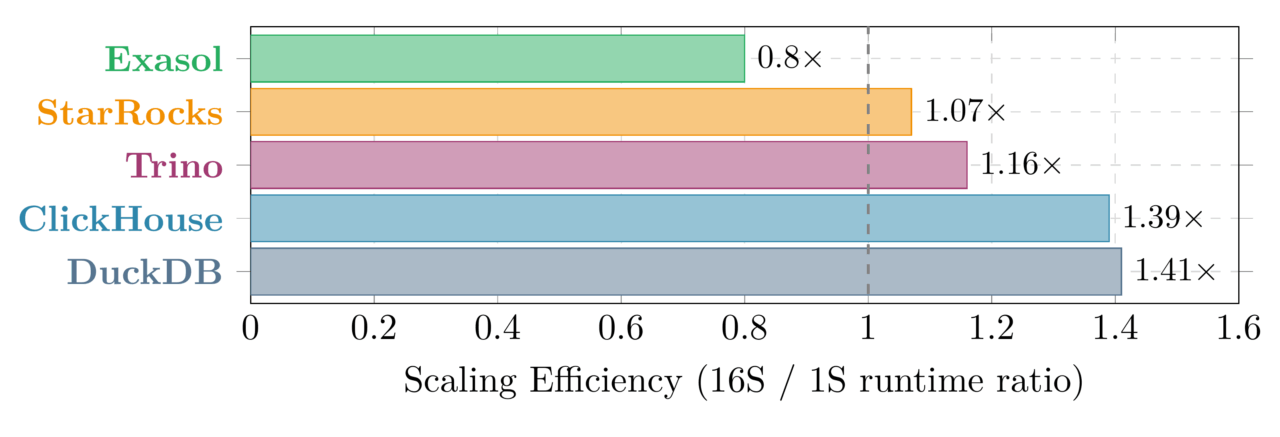
This includes handling more concurrent queries, reading and writing larger datasets, and maintaining consistency across transactions. Each of these places pressure on different parts of the system.
At the compute level, CPU resources determine how many queries can be processed at once. When CPU capacity is reached, query execution slows and queues begin to form. At the storage level, disk I/O limits how quickly data can be read or written. When I/O capacity is saturated, read and write operations are delayed.
Concurrency introduces additional constraints. Multiple queries accessing the same data can lead to contention, especially for write operations. Locking, transaction conflicts, and coordination between nodes increase execution time as concurrency rises.
Scalability depends on how these limits are addressed. Systems can increase available resources, distribute operations across multiple nodes, or reduce the amount of work required per query. The effectiveness of these approaches determines whether the system continues to operate under higher load.
What Makes a Database Hard to Scale?
A database becomes difficult to scale when increasing load exposes coordination and resource limits that cannot be resolved by adding capacity alone.
Write operations are a common constraint. When multiple transactions attempt to modify the same data, the system must coordinate access to maintain consistency. This coordination increases latency and limits throughput as concurrency rises.
Data distribution introduces additional complexity. When data is partitioned across nodes, queries that require data from multiple partitions must coordinate across the network. This adds overhead and increases execution time.
Imbalanced workloads can also create scaling issues. If a subset of data receives most of the traffic, the nodes responsible for that data reach their limits before the rest of the system, leading to uneven resource usage.
Finally, system coordination overhead grows with scale. Replication, consistency checks, and failure handling require communication between nodes, which increases the amount of work required to process each request.
Types of Database Scalability
Database scalability is implemented through different approaches to increasing capacity. These approaches determine how resources are added and how workload is distributed as demand increases. The two primary models are vertical scaling and horizontal scaling, which are influenced by underlying database models that define how data is structured and related.Each model addresses system limits in a different way and introduces different constraints.
| Scaling approach | How it works | What it improves | What limits it |
|---|---|---|---|
| Vertical scaling | Increases CPU, memory, or storage on a single node | Query execution capacity on one system | Hardware limits and single-node contention |
| Horizontal scaling | Distributes data and queries across multiple nodes | Throughput and total system capacity | Coordination between nodes and data distribution overhead |
In addition to these models, systems often separate read and write workloads to reduce contention and improve throughput under load.
Try Exasol Personal for Free
Run real workloads at full Exasol performance.
Vertical Scaling
Vertical scaling increases the capacity of a single database node by adding more CPU, memory, or storage.
This approach allows the system to process more queries in parallel and handle larger datasets without changing the overall architecture. It is typically used when the workload can still be managed within a single machine.
However, vertical scaling is constrained by hardware limits. A single node can only support a finite amount of memory, compute, and I/O capacity. As those limits are approached, further increases require replacing the machine with more powerful hardware.
Vertical scaling does not address coordination or distribution. All queries continue to execute on the same node, which means contention and resource saturation remain tied to that system.
Horizontal Scaling
Horizontal scaling increases capacity by distributing data and workload across multiple database nodes.
Instead of relying on a single machine, the system adds additional nodes and divides work between them. This allows the system to handle higher throughput by processing queries in parallel across multiple machines.
Data is typically partitioned so that each node is responsible for a subset of the dataset. Queries are routed to the relevant nodes, and results are combined when necessary.
Horizontal scaling introduces coordination overhead. Queries that span multiple partitions require communication between nodes, which increases execution time. Consistency and replication also require coordination, adding additional work per operation.
Read Scaling vs. Write Scaling
Read and write operations place different types of load on a database system, and they scale in different ways.
Read scaling is often implemented using replication. Multiple copies of the same data are maintained across nodes, allowing read queries to be distributed. This reduces load on any single node and increases overall read throughput.
Write scaling is more constrained. Write operations must maintain consistency across the system, which requires coordination. When multiple nodes are involved, writes may need to be synchronized or ordered, increasing latency.
Because of this, systems that scale reads effectively may still face limits when write volume increases. Addressing write scaling often requires partitioning data or redesigning how writes are distributed.
Common Challenges
Database scalability is limited by how systems handle coordination, resource contention, and data distribution as load increases.
These constraints become visible when the system processes more concurrent operations than it was originally designed to handle. The limiting factor is not only capacity, but how different parts of the system interact under load.
Write Contention and Transaction Conflicts
Write operations require coordination when multiple transactions modify the same data. The database must ensure consistency, which often involves locking or conflict resolution.
As concurrency increases, more transactions compete for the same resources. This leads to waiting time between operations and reduces the number of writes the system can complete per second.
Systems with high write volume are more likely to encounter these limits, especially when updates are concentrated on a small portion of the dataset.
Data Distribution and Cross-node Queries
When data is distributed across nodes, queries that require data from multiple locations must coordinate across the network.
Each additional node involved in a query increases communication overhead. Data must be retrieved, transferred, and combined before the result is returned.
This affects both latency and resource usage, particularly for queries that scan large datasets or require joins across partitions.
Uneven Workload Distribution
Scalability assumes that workload is distributed evenly across available resources. In practice, access patterns are often uneven.
When a subset of data receives most of the traffic, the nodes responsible for that data reach their limits earlier than others. This creates localized saturation, even if the rest of the system has available capacity.
This issue is commonly tied to how data is partitioned and how requests are routed.
Test Real Analytical Workloads with Exasol Personal
Unlimited data. Full analytics performance.
Replication and Consistency Overhead
Replication increases availability and supports read scaling, but it also introduces coordination requirements.
Changes to data must be propagated across replicas. Depending on the consistency model, this may require synchronization before a write is considered complete.
As the number of replicas increases, the amount of coordination required for each write also increases. This adds latency and reduces the maximum write throughput the system can sustain.
Resource Saturation
Every database system is constrained by CPU, memory, and I/O capacity.
As load increases, one of these resources typically reaches its limit first. For example:
- CPU saturation limits how many queries can be executed in parallel
- Memory limits affect caching and data access speed
- I/O limits delay read and write operations
Once a resource is saturated, additional load results in longer execution times and reduced throughput.
Scaling Challenges in Single-node Database Systems
Some database systems process queries on a single node, even if they support replication or read scaling.
In these systems, write operations are constrained by the capacity of that node. As concurrency increases, transactions compete for CPU, memory, and I/O resources, which limits throughput.
Operations that require coordination, such as updates to shared data, further increase execution time under load. Once the node reaches its limits, additional capacity can only be added by upgrading hardware.
This model simplifies consistency and query execution but creates a fixed upper bound on how much load the system can handle.
Scaling Challenges in Distributed Systems
Distributed systems execute queries across multiple nodes and store data in partitions, depending on the database types used to organize and access data. This removes single-node limits but introduces coordination across the system.
Queries that access multiple partitions require data exchange between nodes. This increases execution time due to network transfer and result aggregation.
Write operations must also maintain consistency across nodes. Depending on the system design, this can require synchronization or coordination between replicas.
Workload distribution becomes critical. If data is not evenly distributed, some nodes reach capacity earlier than others, reducing the benefit of adding more nodes.
Strategies For Improving Database Scalability
Improving database scalability requires addressing the constraints introduced by resource limits, coordination overhead, and data distribution. Each strategy targets a specific limitation in how the system processes load.
Replication
Replication creates multiple copies of the same data across nodes and routes read operations to those replicas.
This reduces the number of read queries handled by a single node and increases total read throughput. It is effective when the workload is read-heavy and the same data is accessed frequently.
Replication does not remove write constraints. Changes to data must still be applied to all replicas, which introduces coordination. As the number of replicas increases, the time required to propagate updates can increase.
Partitioning (Sharding)
Partitioning divides data into subsets and distributes them across multiple nodes. Each node is responsible for a portion of the dataset and handles queries related to that portion.
This reduces the amount of data processed per node and allows write operations to be handled in parallel when they target different partitions.
Partitioning requires a routing mechanism to determine where data is stored. If frequently accessed data is concentrated in a small number of partitions, those nodes reach their limits earlier than others.
Queries that require data from multiple partitions must combine results across nodes, which increases execution time.
Load Distribution
Load distribution controls how requests are routed across available nodes.
Even when data is evenly partitioned, request patterns can create uneven load. Routing strategies determine whether queries are spread across nodes or concentrated on a subset of the system.
Balancing load reduces the likelihood that a single node becomes saturated while others remain underutilized. This improves overall throughput without increasing total system capacity.
Query and Data Access Optimization
Query execution time affects how long system resources are occupied and is directly influenced by database design principles.
Reducing the cost of each query allows more operations to be processed within the same resource limits. This can be achieved by:
- Limiting unnecessary data access
- Using appropriate indexes
- Reducing full-table scans
These changes do not increase capacity directly, but they reduce the pressure on CPU, memory, and I/O resources.
Test Real Analytical Workloads with Exasol Personal
Unlimited data. Full analytics performance.
Resource Scaling
Resource scaling increases the available capacity of the system by adding compute, memory, or storage.
In single-node systems, this involves upgrading hardware. In distributed systems, it involves adding nodes.
This approach increases the amount of work the system can handle, but it does not remove coordination constraints. Without changes to data distribution or workload handling, resource scaling alone may not resolve bottlenecks.
Architecture Selection
Database architecture determines how scaling is implemented.
Single-node systems centralize processing, which simplifies coordination but limits capacity. Distributed systems divide work across nodes, which increases capacity but requires coordination between them.
Choosing an architecture aligned with workload characteristics affects how the system scales under load and which constraints become dominant.
How Cloud Database Scalability Differs
Cloud environments change how database capacity is provisioned and adjusted under load. Instead of relying on fixed hardware, resources can be added or removed through infrastructure controls.
In these environments, compute and storage are decoupled. A database can increase processing capacity or storage independently, depending on which resource becomes constrained.
Cloud platforms also allow capacity changes while the system is running. Nodes can be added, removed, or reconfigured without taking the database offline, which affects how systems handle variable workloads.
Geographical distribution is another factor. Data and compute resources can be placed in different regions, which changes how systems handle latency, replication, and failure scenarios.
These characteristics affect how scalability is implemented, even when the underlying database mechanisms remain the same.
Cloud Scalability vs. Database Scalability
Cloud scalability refers to how infrastructure resources are adjusted in response to demand. This includes provisioning compute instances, storage, and network capacity.
Database scalability refers to how the database system uses those resources to process queries, manage data, and maintain consistency.
A cloud environment can increase available resources, but the database must still distribute workload and coordinate operations. If the database cannot use additional resources effectively, increasing infrastructure capacity does not resolve system limits.
This distinction explains why infrastructure-focused pages can rank for database-related queries. The underlying concepts are related, but they operate at different layers of the system.
When Cloud Architecture Improves Scalability
Cloud architecture provides advantages when workloads change over time or require distribution across regions.
Workloads with variable traffic benefit from the ability to adjust capacity as demand changes. Instead of maintaining peak capacity at all times, resources can be increased during high load and reduced when demand decreases.
Geographical distribution allows systems to place data closer to users. This reduces network latency and enables regional failover when a location becomes unavailable.
Managed infrastructure reduces the operational work required to scale systems. Tasks such as provisioning nodes, replacing failed hardware, and managing capacity are handled by the platform.
These characteristics affect how quickly a system can respond to changes in demand and how much operational effort is required to maintain scalability.
How To Assess Whether Your Database Can Scale
Assessing database scalability requires examining how the system behaves under increasing load, including its real-world scalability behavior under load.
The goal is not to predict exact limits, but to determine how the system responds when demand increases across data volume, concurrency, and query complexity.
Questions To Ask Before Choosing a Scaling Strategy
The following questions help identify which scaling approach is appropriate for a given system:
- How does load increase over time?
Determine whether growth is driven by data volume, number of users, or query frequency. Each type of growth places pressure on different parts of the system. - What is the read-to-write ratio?
Read-heavy systems can distribute queries across replicas. Write-heavy systems require coordination, which limits how quickly throughput can increase. - Are workload patterns stable or variable?
Predictable workloads allow capacity planning in advance. Variable workloads require systems that can adjust capacity while running. - Where does the system reach its limits first?
Identify whether CPU, memory, or I/O becomes saturated under load. This indicates which resource must be addressed to increase capacity. - Do queries depend on data from multiple locations?
Queries that require data from multiple partitions or nodes introduce coordination and data transfer overhead. - What level of availability is required?
Systems that must remain operational during failures require replication and failover mechanisms, which introduce additional coordination. - What operational complexity can be supported?
Distributed systems require monitoring, coordination, and failure handling across nodes. This affects how scaling is implemented in practice.
Try Exasol Personal for Free
Run real workloads at full Exasol performance.
Practical Guidelines for Scaling Database Systems
Scaling decisions are effective only when they target the specific limits observed in the system. Applying changes without identifying the constraint often increases complexity without improving capacity.
Address The Limiting Resource First
Scaling efforts should focus on the resource that reaches its limit under load.
If CPU usage is saturated, query execution must be reduced or distributed. If I/O is the constraint, data access patterns must change. Adding capacity in other areas does not increase throughput if the primary limit remains unchanged.
Reduce Coordination Before Adding Nodes
Distributed systems introduce coordination between nodes. When write contention or cross-node queries dominate execution time, adding more nodes increases coordination overhead instead of increasing throughput.
Reducing coordination, by isolating workloads or limiting cross-node dependencies, often has a larger impact than increasing system size.
Align Data Distribution with Access Patterns
Partitioning is only effective when data distribution matches how the data is accessed.
If frequently accessed data is grouped into the same partition, that node becomes a bottleneck. Distributing data based on access patterns prevents localized saturation and improves load balance across the system.
Separate Read and Write Workloads When Possible
Read and write operations scale differently.
Distributing read queries across replicas reduces load on primary nodes. Write operations, which require coordination, benefit from isolation and reduced contention rather than duplication.
Separating these workloads allows each to be scaled using different approaches.
Measure Behavior Under Load, Not at Idle
Scalability issues appear under sustained load, not during normal operation.
Testing must include:
- Concurrent query execution
- High write volume
- Large dataset access
Observing system behavior under these conditions reveals which constraints limit throughput.
Avoid Scaling All Components at Once
Changing multiple variables at the same time makes it difficult to identify which change improved capacity.
Scaling should be incremental. Adjust one factor, observe the effect, and then apply the next change based on measured results.
Key Takeaways
Database scalability is determined by how a system behaves when core resources reach their limits. The primary constraints are not only data size, but concurrency, coordination, and how workload is distributed.
Different scaling approaches address different limits. Increasing resources expands capacity, but does not resolve contention or coordination overhead. Distributing data and workload removes single-node limits, but introduces communication between nodes.
Scaling decisions depend on how load is generated. Read-heavy systems can distribute queries across replicas, while write-heavy systems are constrained by coordination and data consistency.
System behavior under load provides the most reliable signal. Observing where execution time increases, where resources are saturated, and where coordination delays occur determines which scaling approach is effective.
Test Real Analytical Workloads with Exasol Personal
Unlimited data. Full analytics performance.
Frequently Asked Questions
A database becomes scalable by addressing the limits that appear under load.
This typically involves distributing workload across nodes, reducing contention between operations, and ensuring that data access is balanced across the system. The specific approach depends on whether the constraint is caused by CPU, I/O, concurrency, or coordination between nodes.
Database scaling is commonly divided into two models.
Vertical scaling increases the capacity of a single node by adding more resources such as CPU or memory. Horizontal scaling distributes data and workload across multiple nodes, allowing the system to process queries in parallel.
These models address different limits and are often used together in practice.
Databases are often grouped by how they store and access data.
Common categories include relational databases, key-value stores, document databases, and column-oriented databases. Each category uses a different data model and supports different query patterns.
These differences affect how each system handles data distribution, query execution, and scaling.
SQL-based systems are often associated with strong consistency and transactional guarantees.
These guarantees require coordination when multiple transactions modify data, which limits how quickly write throughput can increase under high concurrency. Scaling such systems typically requires distributing data and coordinating operations across nodes.
This constraint is related to system design, not the SQL language itself.
Scalability describes whether a database can increase its capacity without changing its core structure.
This involves adding resources, distributing workload, or adjusting how data is processed so that the system can handle higher throughput.
Scalability depends on system design, not only on the database type.
Factors such as data distribution, query execution model, and coordination between nodes determine how a database behaves under load. Different systems optimize for different workloads, which affects how they scale in practice.