

MPP Database: How Massively Parallel Processing Works

A massively parallel processing (MPP) database distributes query execution across multiple processing nodes. Each node handles part of the execution plan, often on a different portion of the data. The system then combines the partial results. MPP databases are commonly used in data warehouses and other analytical systems that scan, join, and aggregate large datasets.
This architecture can reduce query time by processing parts of a query in parallel. Performance still depends on data distribution, query design, network exchange, memory use, storage performance, and workload management.
What is an MPP database?
Massively parallel processing (MPP) is an architectural approach that distributes database processing across multiple nodes or compute resources. It describes how the system executes work. The logical data model and storage layout are separate characteristics.
An MPP database may use a relational data model, columnar storage, in-memory execution, or a combination of these characteristics. These elements describe different layers of the database architecture.
MPP databases are commonly used for data warehousing because analytical queries often scan, join, and aggregate large datasets. An MPP data warehouse uses this architecture to execute analytical workloads across multiple processing resources.

Try Exasol Personal for Free
Run real workloads at full Exasol performance.
How does an MPP database work?
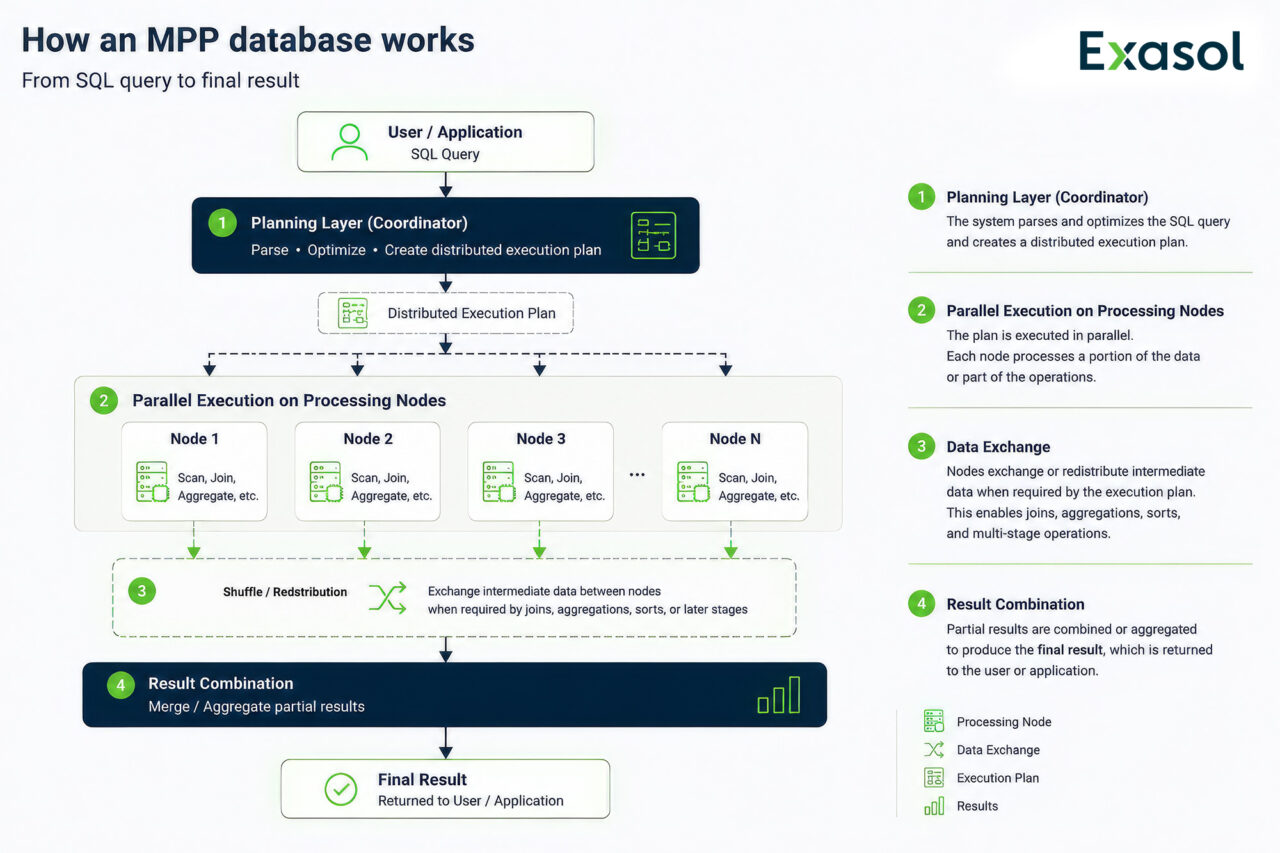
An MPP database converts a SQL query into a distributed execution plan that can run across multiple processing nodes. The system coordinates these operations, exchanges intermediate data when necessary, and combines the partial results.
A simplified MPP query flow has five stages:
- The database parses and optimizes the SQL query.
- The optimizer creates a distributed execution plan.
- Processing nodes run scans, joins, aggregations, or other assigned operations in parallel.
- Nodes exchange or redistribute intermediate data when joins, aggregations, sorts, or later execution stages require it.
- The system combines the partial results and returns the final result.
Query planning and coordination
The query optimizer is one of the core components of a database and determines the operations, execution order, and data-distribution requirements for the query plan. It uses table statistics, data distribution, join conditions, filters, and other physical design information to select an execution plan.
A coordination layer manages dependencies between query stages and monitors execution progress. Some MPP systems use a dedicated coordinator node. Others distribute coordination across several services or hide it behind a managed execution layer.
An inefficient distributed plan can create unnecessary scans, data movement, or uneven work across processing resources.
Processing resources and distributed data
Processing nodes, workers, or other compute resources provide the CPU and memory used for query execution. Each resource executes assigned scans, joins, aggregations, sorts, or other parts of the plan.
MPP databases also distribute data or data access so several processing resources can work at the same time. Classic shared-nothing systems commonly store data partitions close to the nodes that process them. Systems with separated compute and storage assign data access from a shared storage layer.
The storage model affects how quickly processing resources can access the required data and how much information must move during execution.
Parallel scans, joins, and aggregations
MPP benefits large query operations that can be divided into parallel tasks. Processing nodes can scan different portions of a table, calculate partial aggregations, or complete parts of a join at the same time.
For example, each node may calculate regional sales totals from its assigned data. The database then combines those partial totals to produce the result for the complete dataset.
Data exchange and redistribution
Some operations can use data already available to each processing resource. Others require communication through a network or distributed shuffle layer.
A join may redistribute rows so matching values reach the same resource. A global aggregation or sort may require additional exchange, merge, or reduction stages.
Network bandwidth and latency can affect performance when a query moves large intermediate datasets. Data movement can also increase memory use and processing time.
Combining partial results
After processing resources complete their assigned work, the database combines the partial results. This may involve merging sorted values, calculating final aggregates, or collecting result sets from several nodes.
The coordination layer then returns the completed result to the requesting user or application.
Resource and workload management
Several queries may compete for CPU, memory, network bandwidth, and execution capacity. Workload-management controls determine when queries run and how the database shares those resources.
Depending on the platform, these controls may include priorities, queues, admission rules, resource groups, or workload classes. They reduce the risk that one resource-intensive query consumes the capacity required by other users or workloads.
How data distribution affects MPP performance
MPP databases distribute data, data access, or query work across processing resources so operations can run in parallel. The distribution model influences workload balance and the amount of data the system moves during execution.
Common data distribution methods
Hash distribution assigns rows using one or more distribution columns. A suitable key can keep related rows together and reduce data movement during joins and aggregations.
Round-robin distribution spreads rows without using their values. It can balance row counts, but related rows may require redistribution during query execution.
Replication copies a small table to each relevant processing resource. This can reduce movement during joins but increases storage and write overhead.
Platforms differ in how much control they expose. Some require users to choose distribution keys or table layouts. Other platforms select table distribution automatically or repartition intermediate data during execution.
Data locality and redistribution
A query can process data locally when the required rows are already available to the same processing resource without redistribution. Local processing reduces network exchange and allows processing resources to complete more work independently.
Joins may require redistribution when matching rows reside on different resources. The system may repartition one or both datasets or broadcast a smaller dataset to the participating resources. These exchanges can consume network bandwidth, memory, and processing time.
How can teams reduce data skew in an MPP database?
Data skew occurs when rows are distributed unevenly across processing resources. Workload skew occurs when a query assigns substantially more processing to some resources than others.
The busiest resource can delay the complete query while other resources finish early and remain idle. Common causes include:
- Distribution columns with few distinct or highly concentrated values
- Filters or joins that concentrate work on a small number of resources
- Intermediate results or changing data patterns that create uneven processing
A balanced row count does not always produce a balanced workload. Some rows may require more processing, or a query may concentrate its work on a small part of the distributed data.
Reducing distribution problems
Evaluate distribution using representative queries rather than table size alone. Useful checks include row distribution, execution time by node or stage, and data-transfer volume. The appropriate design keeps common joins local, balances processing work, and limits unnecessary exchange.
Try Exasol Personal for Free
Run real workloads at full Exasol performance.
How does massive parallel processing improve database performance?
MPP can reduce query time by running independent parts of an analytical query across multiple processing resources. Each resource handles part of the execution plan, reducing the amount of work any one resource must complete.
The performance gain depends on how much of the query can run in parallel. Large scans, joins, aggregations, and sorts can benefit when the database divides them into parallel stages. Short lookups and operations with limited parallelism usually gain less.
Parallel scans and filtering
Processing resources can scan different data segments at the same time. When the execution plan applies filters during the scan, each resource can remove irrelevant rows before later stages process them.
Early filtering can reduce the amount of data used by later joins and aggregations. The optimizer must place filters early enough to reduce downstream processing and data exchange.
Parallel joins and aggregations
MPP databases can divide joins and aggregations into smaller operations that run across multiple resources. Each resource may join local data, calculate partial totals, or group values from its assigned segment.
The system then exchanges or combines the intermediate results. Performance depends on whether matching rows are already colocated and how much data must move between resources.
For example, several resources can calculate sales totals for separate data segments. A later stage combines those partial totals into the final result.
Distributed compute and memory
An MPP system provides CPU and memory across multiple processing resources. Distributed execution can make more total compute and memory available to suitable query stages than a single server can provide.
Adding resources can increase processing capacity, but the improvement may not be proportional. Coordination, data movement, storage throughput, and uneven workloads can limit the benefit.
Complementary performance techniques
MPP often works with columnar storage, compression, in-memory processing, vectorized execution, and cost-based optimization. An in-memory database can reduce storage access when active data and intermediate results remain in memory. These techniques can reduce storage access, data transfer, or processing overhead, but they describe separate parts of the database architecture.
When MPP provides limited benefit
MPP provides less benefit for small lookups, highly selective queries, and operations with limited parallelism. Performance can also decline when data is unevenly distributed, query stages exchange large intermediate datasets, storage or network throughput becomes a bottleneck, or concurrent queries compete for resources.
Query structure, data distribution, physical design, and workload management determine the practical result.
What are the pros and cons of shared-nothing MPP architectures?
In a classic shared-nothing MPP architecture, each processing node has its own CPU, memory, and storage resources. The database distributes data and query stages across these nodes. Nodes process their assigned work independently and exchange intermediate results over a network when a query requires coordination.
Some analytical platforms use shared-nothing compute with a separate storage layer. Processing resources remain independent, but they access data from shared or centralized storage instead of permanently storing every assigned partition locally.
Shared-nothing architecture supports the general benefits of MPP, including parallel query execution, distributed compute capacity, and scale-out processing. Its practical performance depends on how evenly the database distributes data and work and how much information moves between nodes.
| Benefits | Limitations |
|---|---|
| Parallel scans, joins, aggregations, and sorts can reduce query time for large analytical workloads. | Data or workload skew can leave some nodes overloaded while others finish early. |
| CPU and memory capacity is distributed across several processing nodes. | A query can still be constrained by one slow node, stage, or per-node resource limit. |
| Teams can add processing nodes as data volume or analytical demand grows. | Additional nodes do not guarantee proportional performance gains. |
| Local scans and joins can reduce network exchange when related data is assigned to the same node. | Distributed joins, global aggregations, and sorts may require substantial data movement. |
| Independent nodes reduce contention for one shared CPU or memory pool. | Coordination overhead can increase as more nodes participate in an execution stage. |
| Separate node resources create distinct resource and failure boundaries. | Availability depends on product-specific replication, redundancy, failover, and recovery mechanisms. |
| Distributed capacity can support concurrent analytical workloads when the database manages resources effectively. | Concurrent queries can still compete for CPU, memory, network bandwidth, and execution capacity. |
| Scale-out systems can increase aggregate processing capacity without relying on one larger server. | Systems with node-local storage may need to redistribute data when nodes are added, removed, or resized. |
When shared-nothing MPP fits the workload
Shared-nothing MPP suits analytical workloads built around large scans, joins, aggregations, and sorts. It works most effectively when data and processing remain balanced and common operations require limited redistribution.
It may provide less benefit for small lookups, short transactions, sequential operations, or datasets that fit within one server. Workload patterns, latency requirements, operational effort, and cost should determine the architectural choice.
MPP versus SMP
Massively parallel processing (MPP) distributes query execution across multiple processing nodes with independent compute resources. Symmetric multiprocessing (SMP) uses several processors or cores within one system that share memory and other hardware resources. Both architectures can use parallel query execution. The difference lies in how they organize compute, memory, storage, and communication, and how they approach database scalability.
| Characteristic | MPP | SMP |
|---|---|---|
| Processing model | Distributes work across multiple nodes | Divides work across processors within one system |
| Memory | Each node has independent memory in a classic shared-nothing system | Processors share one memory space |
| Storage | May use node-local, distributed, or separated storage | Processors access storage through the same system |
| Communication | Uses a network or interconnect between nodes | Uses shared memory and internal system interconnects |
| Scaling model | Commonly adds nodes to scale out | Commonly adds resources to scale up |
| Typical workload | Large analytical workloads that divide effectively across nodes | Operational or analytical workloads that fit within one shared-memory system |
| Main constraint | Data movement, coordination, and skew | Shared-resource contention and server capacity |
What are the main differences between OLTP and MPP databases?
MPP describes an execution architecture that distributes processing across multiple resources. Online transaction processing (OLTP) describes workloads built around frequent, short transactions such as inserts, updates, deletes, and record lookups.
These categories can overlap. An MPP database may support transactional SQL, while a distributed OLTP database may process transactions across several nodes. In practice, analytical MPP databases and OLTP-focused databases optimize for different access patterns.
| Characteristic | Analytical MPP database | OLTP-focused database |
|---|---|---|
| Primary workload | Large scans, joins, aggregations, and reporting queries | Short inserts, updates, deletes, and record lookups |
| Data access | Often processes many rows or columns per query | Usually accesses a small number of records per transaction |
| Execution priority | Throughput and latency for analytical queries | Low transaction latency and high commit throughput |
| Data organization | Often uses columnar storage and warehouse-oriented schemas | Often uses row-oriented storage and operational schemas |
| Scaling approach | Commonly distributes query work across nodes | May scale vertically or distribute transactions across nodes |
| Common use cases | Data warehousing, BI, reporting, and exploration | Order processing, payments, inventory, and operational applications |
These are common patterns rather than fixed rules. Products differ in their storage models, transaction support, consistency controls, and execution architecture.
How is MPP architecture used in online transaction processing?
Distributed OLTP databases can partition data and transaction processing across several nodes. Transactions accessing separate data can run concurrently, while cross-node transactions require additional coordination.
Cross-node transactions may use distributed concurrency control and commit coordination. Replication and consensus mechanisms may also maintain consistent state across nodes, depending on the product. These mechanisms can add latency compared with transactions completed within one node or part of the key space.
Distributed OLTP systems often colocate data accessed within the same transaction to reduce cross-node coordination. A platform might partition data by customer, account, region, or another key aligned with common transaction patterns.
Can an MPP database support OLTP?
An MPP database may support inserts, updates, deletes, and ACID transactions without being optimized for high volumes of short operational transactions. Analytical MPP systems commonly prioritize scans, joins, aggregations, and reporting. Frequent single-row changes may create additional logging, indexing, storage, or coordination work.
Some distributed databases support transactional and analytical workloads in one system. Suitability depends on transaction volume, commit latency, isolation requirements, analytical complexity, and cross-node coordination.
Try Exasol Personal for Free
Run real workloads at full Exasol performance.
How have MPP implementations changed?
MPP still describes distributed query execution across multiple processing resources. What has changed is how platforms organize compute, storage, scaling, and administration.
Provisioned node-based clusters
Earlier MPP systems commonly ran on provisioned clusters. Each processing node supplied CPU and memory, and many systems stored part of the database on node-attached or distributed storage.
The database divided data and query stages across the nodes. Nodes processed their assigned work and exchanged intermediate results when joins, aggregations, sorts, or other stages required coordination.
This model can give teams direct control over node count, storage capacity, network configuration, redundancy, and maintenance timing. It also requires the organization to size, operate, and resize the cluster.
Separated compute and storage
Many modern analytical platforms separate persistent storage from compute. Processing resources read the required data from shared or centralized storage and may use local caches or shuffle services during query execution.
This design can allow teams to:
- Scale compute and storage independently
- Change processing capacity without moving the complete dataset
- Run several compute clusters against one data store
- Separate workloads across clusters or compute pools
The design changes how teams operate and scale the database. Query performance still depends on storage throughput, caching, scheduling, data movement, and workload placement.
Managed and multi-cluster execution
Managed platforms may hide the physical nodes used for query execution. Users may select a service tier, reservation, warehouse size, or amount of compute capacity instead of configuring individual servers.
Some systems add clusters, warehouses, or compute pools to increase concurrency and reduce workload interference. Increasing one cluster’s size may improve the resources available to an individual query, while adding clusters may primarily increase concurrent capacity. Teams should compare both effects and the associated cost.
Examples of MPP database systems
Examples of MPP databases and related distributed analytical systems include Exasol, Amazon Redshift, Snowflake, Teradata Vantage, and Microsoft Fabric Data Warehouse. These systems distribute query work across multiple compute resources, but their terminology and architectural models differ.
| Platform | Architectural description | Deployment | What to evaluate |
|---|---|---|---|
| Exasol¹ | An in-memory, columnar analytics database that uses MPP to distribute scans, joins, and aggregations across cluster nodes. | Customer-controlled infrastructure, on-premises, hybrid, cloud instances, or SaaS (Enterprise and Personal editions) | Complex analytical SQL, BI concurrency, in-memory processing, workload prioritization, and deployment control |
| Amazon Redshift² | Amazon Redshift provisioned clusters use an MPP architecture with leader and compute nodes. RG and RA3 clusters use managed storage that scales separately from compute. | AWS managed service, including provisioned and serverless options | Data distribution, workload management, AWS integration, concurrency, and compute-sizing model |
| Snowflake³ | A hybrid architecture combining centralized persistent storage with MPP virtual warehouses. Multi-cluster warehouses add clusters to address concurrency. | Public cloud on AWS, Azure, or Google Cloud | Workload separation, concurrency scaling, warehouse sizing, public-cloud-only deployment, and credit consumption |
| Teradata Vantage⁴ | A multinode MPP architecture built from connected SMP nodes. BYNET handles communication between nodes. | Teradata Vantage deployment options | Enterprise warehouse requirements, workload management, migration effort, and operational model |
| Microsoft Fabric Data Warehouse⁵ | A managed data warehouse that uses distributed query processing and massive parallel query execution. | Microsoft Fabric managed service | T-SQL support, Power BI integration, Fabric capacity, concurrent demand, and cost |
Sources:
¹ Exasol database overview and Exasol documentation.
² Amazon Redshift architecture and provisioned-cluster documentation.
³ Snowflake architecture and multi-cluster warehouse documentation.
⁴ Teradata Vantage SMP and MPP platform documentation.
⁵ Microsoft Fabric Data Warehouse architecture.
The terms MPP database, distributed analytical database, and cloud data warehouse overlap, but they don’t describe identical architectures.
How to choose an MPP database
No single MPP database suits every workload. Compare platforms based on query patterns, concurrency, data movement, deployment requirements, operational effort, governance, and cost.
Use representative data and workloads rather than architecture labels or isolated benchmark results. A platform that performs well for one complex query may behave differently when dashboards, data loads, transformations, and reports compete for the same resources.
Define the workload and success criteria
Document the queries, users, data operations, and response-time requirements the database must support.
Define:
- Data volume, growth, and query scan size
- Common joins, aggregations, sorts, and transformations
- Concurrent users, applications, and background jobs
- Response-time, governance, and deployment requirements
Set measurable success criteria before comparing products. These may include completed queries per unit of time, median and tail latency, queue time, failure rate, data-load duration, operating cost, and recovery time after a demand spike.
Which MPP databases deliver the best concurrency for BI users?
BI concurrency results vary by workload, query mix, available capacity, and resource-management model. No database provides the best result for every BI environment.
Individual-query performance and concurrency measure different behavior. A database may execute one query quickly by assigning it substantial resources, then slow down when many dashboards, applications, and background jobs run at the same time.
Compare how each platform:
- Scheduling and queueing
- CPU and memory allocation
- Workload priorities and limits
- Separate or shared compute capacity
Some platforms manage contention through shared-resource scheduling. Others use separate clusters, warehouses, or compute pools. Shared resources can improve utilization, while separate compute resources can reduce workload interference. Each model affects cost and unused capacity differently.
Test concurrency with a mix of:
- Dashboard and reporting queries
- Large joins and transformations
- Data loads and background jobs
Measure completed queries per unit of time, median and tail latency, queue time, failed or timed-out queries, and the time required to recover after a demand spike.
Our published test compares how five analytical databases scale across concurrent users, data volume, and node count.
Try Exasol Personal for Free
Run real workloads at full Exasol performance.
Evaluate data movement and scaling
Data distribution affects workload balance and network exchange. Review how the platform distributes table data, handles skew, colocates common joins, and redistributes intermediate results.
Some databases require distribution keys or table-layout decisions. Others automate or abstract these choices. Automation can reduce administration, but teams should still inspect data movement and execution time by node or stage.
Also determine what happens when capacity changes:
- Can compute scale without moving the complete dataset?
- Does scaling improve one query, concurrent workloads, or both?
- Does scaling interrupt work or redistribute data?
- How do performance and cost change as capacity increases?
Additional compute does not guarantee proportional gains. Query structure, skew, storage throughput, data exchange, and sequential stages can limit the improvement.
For in-memory systems, confirm which data and intermediate results remain in memory, what happens when memory is exhausted, and how memory is shared across concurrent workloads.
Validate SQL, deployment, and operations
Confirm the platform supports the required SQL features, data types, query patterns, BI tools, and data integrations.
Review its diagnostic capabilities, including:
- Query plans and profiling
- Statistics collection
- Resource monitoring
- Workload-management visibility
- Failure and timeout reporting
Compare the available deployment models against data residency, security, network access, disaster recovery, staffing, and upgrade requirements.
Operational effort also matters. Determine whether teams must manage distribution, cluster sizing, workload queues, statistics, storage, backups, or software upgrades.
Compare complete workload cost
List price alone does not show the cost of operating an MPP database.
Where applicable, include:
- Compute and storage
- Data transfer
- Idle capacity
- Concurrency scaling
- Additional clusters
- Licenses and support
- Administration and infrastructure
Compare the cost of completing the same workload within the required performance targets. A low cost per isolated query may not remain low after concurrency, idle resources, workload separation, and administration are included.
Run a representative proof of concept
Use representative data, production query patterns, and database benchmarks that measure concurrency and query failures rather than relying on isolated query timings.
The proof of concept should include:
- Large analytical scans
- Complex joins and aggregations
- Concurrent dashboard queries
- Data loading and transformation
- Workload prioritization
- Capacity constraints and scaling
- Recovery from failures or demand spikes
Give each platform the same dataset, workload, success criteria, test duration, and agreed tuning period. Repeat the tests to identify variance.
Record throughput, median and tail latency, queue time, failures, resource use, tuning effort, operational work, and cost. Choose the database that meets the organization’s performance, concurrency, deployment, governance, cost, and operational requirements.
How Exasol uses MPP for enterprise analytics
Exasol is an in-memory, columnar analytics database that uses MPP across cluster nodes. Distribution keys can control how table data is assigned between nodes.
Parallel analytical query execution
Exasol combines MPP across cluster nodes with multithreaded execution within each node. Columnar and in-memory processing reduce unnecessary storage access, while the cost-based optimizer creates plans using automatically gathered statistics.
These mechanisms support BI dashboards, reporting, ad hoc analysis, large joins, and repeated aggregations. Actual performance depends on query structure, data distribution, available resources, and concurrent demand. Exasol’s documentation identifies data distribution and hardware performance issues as factors that can reduce query performance.
Concurrency and workload management
Exasol’s resource manager allocates resources through consumer groups assigned to users and roles. Administrators can assign CPU weights, prioritize users or roles, and set temporary database memory limits, query timeouts, and session limits.
When parallel query demand exceeds the available processor cores, the resource manager schedules queries through a time-slot model. This scheduling prevents uncontrolled resource consumption from reducing throughput.
For example, a team can assign dashboard users to a higher-weight consumer group and background transformation users to a lower-weight group. These controls provide different resource shares and limits. They don’t create physical workload isolation.
Compute, storage, and deployment options
Exasol offers Enterprise and Personal editions. Exasol Enterprise is available as a managed SaaS service or for customer-controlled deployment in on-premises, hybrid, and public-cloud environments. Exasol Personal is free for individual use and can run locally or in the user’s own cloud account.
Each cluster connects directly to users and the central data store. The main cluster maintains a consistent view of transactions and metadata across worker clusters.
Teams can increase the CPU and memory available to a cluster, add worker clusters for concurrency or workload separation, and stop clusters when they aren’t needed. Cluster size, the number of active clusters, and cluster runtime affect available compute capacity and infrastructure charges.
When to evaluate Exasol
Teams should test these capabilities with representative data, queries, concurrency levels, and background workloads.
Try Exasol Personal for Free
Run real workloads at full Exasol performance.
Frequently asked questions about MPP databases
An MPP database distributes a query across multiple processing nodes so each node can scan, join, or aggregate part of the data in parallel. The database then combines the partial results. MPP databases are commonly used for data warehousing, BI, and analytical workloads that process large datasets.
The standard SQL Server Database Engine isn’t a classic MPP database. It can run parallel query plans across processors in an SMP system. Microsoft platforms with distributed MPP execution include Azure Synapse dedicated SQL pool and Microsoft Fabric Data Warehouse.
Yes. Snowflake processes queries through massively parallel processing compute clusters called virtual warehouses. Its hybrid architecture combines centralized persistent storage with independent MPP compute clusters, allowing storage and compute resources to scale separately.
Examples of MPP databases and distributed analytical warehouses include Exasol, Amazon Redshift, Snowflake, Teradata Vantage, and Microsoft Fabric Data Warehouse. These products differ in storage architecture, deployment options, workload management, concurrency controls, and cost. Buyers should compare them using representative queries and concurrent workloads rather than popularity alone.