

What If Your Database Could Talk to AI? (MCP)

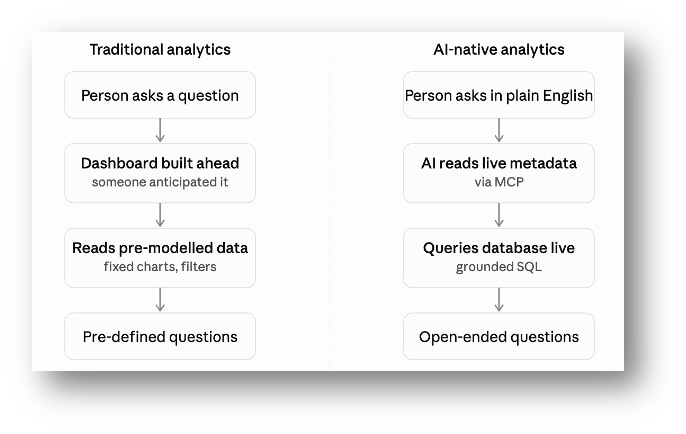
Dashboards answer questions someone already knew to ask. Somebody built them in advance, guessing which questions would matter, and they handle those questions well and nothing else. What people want now is different. They want to ask a question the way they’d ask a colleague, in plain words, and get a real answer back.
That move from pre-built dashboards to conversation is what AI-native analytics means.
MCP in One Paragraph
MCP is an open standard from Anthropic that gives an AI agent a structured, governed way to talk to a system like a database. Rather than improvise, the agent finds out what’s there, learns the rules it has to work within, and calls defined tools to get what it needs. Think of it as what REST did for software, applied to AI agents. The more useful question is what MCP enables. It’s what happens when you point it at a database, and why that beats letting the model guess.
The One Idea That Matters: Metadata Discovery
If you keep one concept from this piece, keep this one.
When you ask a plain-language question, the hard part for the AI isn’t writing SQL. Models are already good at SQL in general. The hard part is knowing your specific database. What tables exist. What the columns are really called. How they join. What types they hold. Without that, even a strong model guesses, and a guess is where things go wrong. It writes customers when your table is CUSTOMER. It sums a total_sales column that was never there. Then it hands you a confident answer built on names it invented.
Metadata discovery takes the guessing away. Through MCP, before it writes any SQL, the agent looks up the real schemas, reads a table’s actual columns and types, and sees how tables link through their keys. The query it writes then rests on what your database actually contains. That is the line between an AI that gives you demo answers and one you can point at real data.
Here’s why it’s such a jump. Every earlier method tried to hand the model a description of the database and hoped the description was right and current. Metadata discovery lets the model read the structure itself, at the moment it needs it, so the picture can’t fall out of date. The model stops working from a photo of the room and walks into it instead. Almost everything good about AI-native analytics comes from that one change.
Why not the Approaches We Already Have?
Metadata discovery is also what sets MCP apart from the patterns teams have bolted together for years. Each of those carried a weakness worth naming, because “we already do text-to-SQL” is the usual reason people wave MCP off.
A hand-maintained connector pastes the schema into the prompt by hand. It breaks the moment the schema changes, and you rebuild it for every new model. Retrieval over schema docs, the RAG approach, pulls text that looks similar to the question rather than the structure that’s correct, and it can’t see live values or run anything. Plain text-to-SQL leans on the model’s training plus whatever schema string you paste in, so it invents columns and joins with no way to check itself. A semantic layer works, but it’s heavy to build and static once built, and it only answers what someone modelled ahead of time.
MCP is a different kind of thing. It gives the agent typed access to the database: list the schemas, describe a table’s real columns and constraints, run a query, each through a defined tool that returns a defined result. The agent works from live truth instead of a stale description.
MCP is Bigger Than any One Database
This part matters, because it’s why MCP is a standard rather than a vendor feature. Anthropic introduced it as an open protocol, and support now spans a widening set of AI clients: Claude and Claude Desktop, Cursor, GitHub Copilot, VS Code, OpenAI’s tooling, and more. On the other side, MCP servers are showing up for databases, file systems, developer tools, and SaaS products.
A shared standard means the parts fit together. Any compliant client can talk to any compliant server. Learn MCP once and you can connect many models to many tools, and what you learned still applies. Exasol is one server in that ecosystem, and because it speaks the same protocol as the rest, it slots into whatever assistant a team already runs.
Where Exasol Fits
So what kind of database belongs on the other end of an MCP connection? AI agents are talkative and impatient. They ask a lot of questions, refine, and ask again, often several at once. That pattern rewards a database built for fast analytical queries under concurrent load, which is what Exasol is for. Put an MCP connection in front of it and the plain-language experience stays fast enough to feel like talking rather than waiting. How the Exasol server works in detail, its exact tools, and how it enforces read-only access, is a topic for a follow-on piece.
What This Means for the Next Few Years
The direction is not hard to read. Dashboards won’t vanish, but they stop being the only door in. A dashboard becomes one view among several, next to a conversation that handles the questions nobody pre-built.
As MCP support lands in the tools people already use, talking to your data will feel as ordinary as searching it does now. Analysts will write fewer queries by hand and spend more time choosing which questions are worth asking. Agents will grow from answering one question to running multi-step analysis on their own, checking each step against live metadata as they go. The teams that get the most out of this will be the ones who made the access governed from day one, so that opening a database to AI never meant losing control of it.
Underneath all of it sits a change in what a database is for. For decades it was somewhere you stored data and queried on its own terms. It’s turning into something you can talk to. MCP is the standard moving that from a demo into plumbing you can rely on, and it’s worth watching, because working with data is about to feel different.
Go deeper
- MCP specification — the protocol itself: modelcontextprotocol.io
- Exasol MCP Server — source and issues: github.com/exasol/mcp-server
- Full tool reference — every tool, argument, and return shape: the tool list
- Exasol Personal Starter Kit — try it locally in minutes: curl -fsSL https://raw.githubusercontent.com/exasol-labs/exasol-personal-local-starterkit/main/install.sh | sh
- Next in this collection — Can AI Learn Your Database? (Agent Skills), on teaching the model Exasol’s specifics so its generated SQL is right the first time
The Takeaway
The next leap in AI won’t come from smarter models alone. It comes from smarter systems — where the agent discovers real metadata, generates SQL grounded in it, executes under real permissions, and leaves an audit trail, instead of three of those being duct-taped on afterward. MCP is the standard that makes that loop portable across clients, and a database built for analytical load is what makes it fast enough to feel conversational. That’s the combination worth bookmarking.