

Can AI Learn Your Database?

Teaching Assistants to work with Exasol
Large language models have transformed the way developers work. Today, asking an AI assistant to write SQL, explain a query, or generate Python code feels as natural as searching the web. But once you start using AI with a real database, you quickly discover an important limitation.
General-purpose models understand SQL and common database concepts, but they don’t automatically understand Exasol-specific SQL syntax, User Defined Function (UDF) conventions, BucketFS, or documented best practices. Without that context, they fill the gaps with assumptions that may not always produce the right result.
Connecting an AI assistant to a database is only part of the solution. To be truly useful, it also needs to understand how to work with that database.
That’s where Agent Skills come in.
Why Access Isn’t the Finish Line
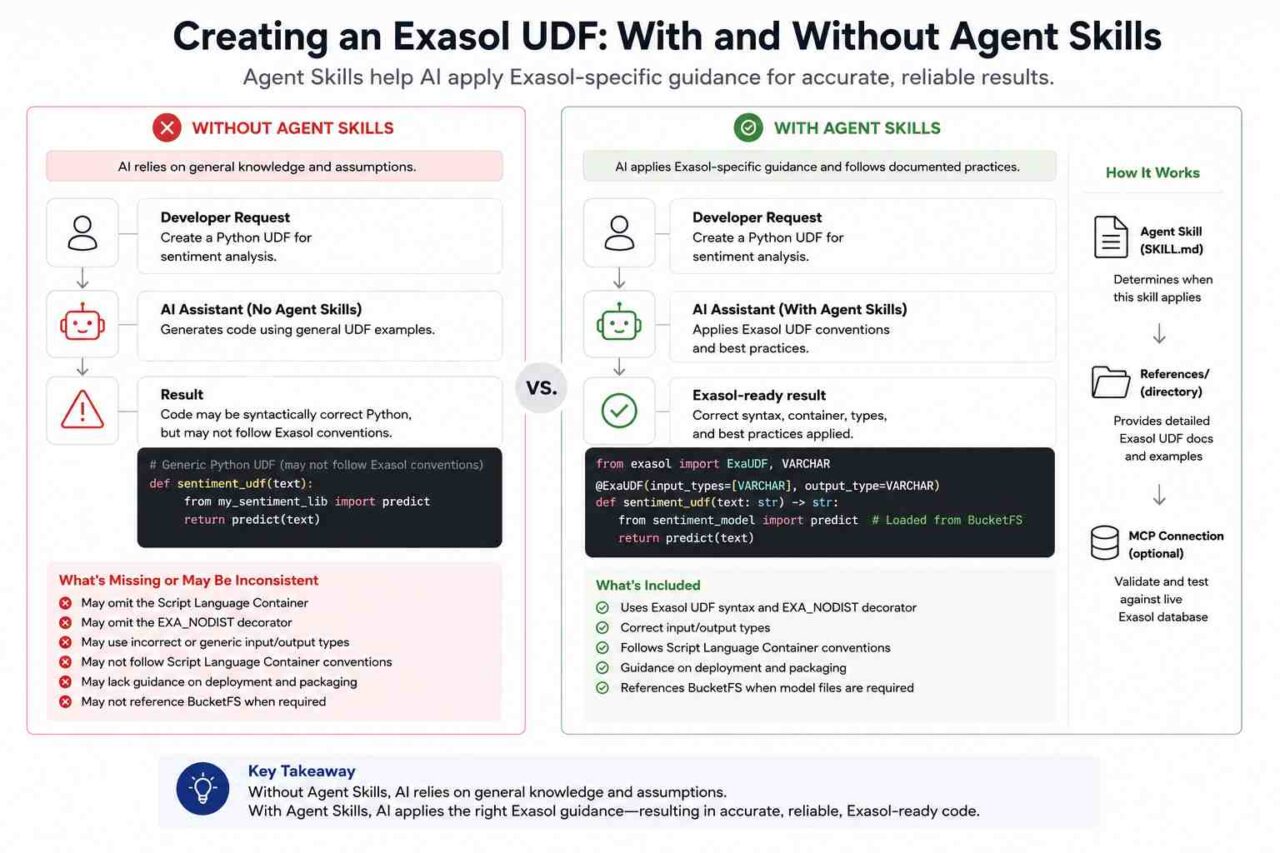
Imagine asking an AI assistant to create a Python UDF for sentiment analysis.
A general-purpose model can generate Python code and understands the concept of a UDF. But the model doesn’t automatically know Exasol’s UDF conventions, how Script Language Containers are used, or when BucketFS is involved.
You could include all of that guidance in every prompt. But over time, those prompts become longer, harder to maintain, and difficult to keep consistent across a team.
The challenge isn’t simply giving an assistant access to your database—it’s giving it the guidance to use that access correctly.
Rather than repeating the same instructions in every conversation, Exasol packages that guidance into reusable Agent Skills that AI coding assistants can use when needed.
The difference is easiest to see with a practical example. The comparison below shows how the same request is handled with and without Agent Skills.
Teaching Instead of Repeating
Instead of embedding Exasol-specific guidance into every prompt, that guidance can be packaged into a reusable skill.
For example, without Agent Skills, you might explain Exasol’s Python UDF conventions every time you ask an AI assistant to generate one. With Agent Skills, those instructions are packaged once and reused whenever the assistant encounters the same type of task.
After installing Agent Skills, AI assistants can apply Exasol-specific guidance that goes beyond their general training data. Rather than relying only on generic database knowledge, the assistant can use Exasol-specific instructions, examples, and references while generating its response.
The result is responses that are more accurate and aligned with Exasol guidance without repeatedly explaining the same concepts.
What Is an Agent Skill?
An Agent Skill is a reusable guidance package that teaches AI coding assistants how to work with Exasol.
Each skill focuses on a specific capability and provides structured instructions that help the assistant perform Exasol tasks more accurately.
Every Agent Skill is built around a SKILL.md file that describes what the skill does, when it should be used, and how the assistant should approach the task.
Additional technical documentation can be stored in a references/ directory. This allows the assistant to retrieve more detailed guidance only when the task requires it, keeping the initial context concise while still providing access to deeper technical information.
Progressive Knowledge, Not Bigger Prompts
One important design principle behind Agent Skills is progressive disclosure.
Rather than loading an entire set of documentation into the model’s context window, the assistant starts with the guidance in the SKILL.md file. If additional detail is required, it can follow references to supporting documentation stored alongside the skill.
This approach keeps the assistant focused on the current task while still making comprehensive technical guidance available when needed.
Instead of creating increasingly complex prompts, developers can organize reusable Exasol knowledge into skill packages that are easier to maintain and reuse.
How Agent Skills Complement MCP
Agent Skills are often used alongside the Model Context Protocol (MCP), but they solve different problems.
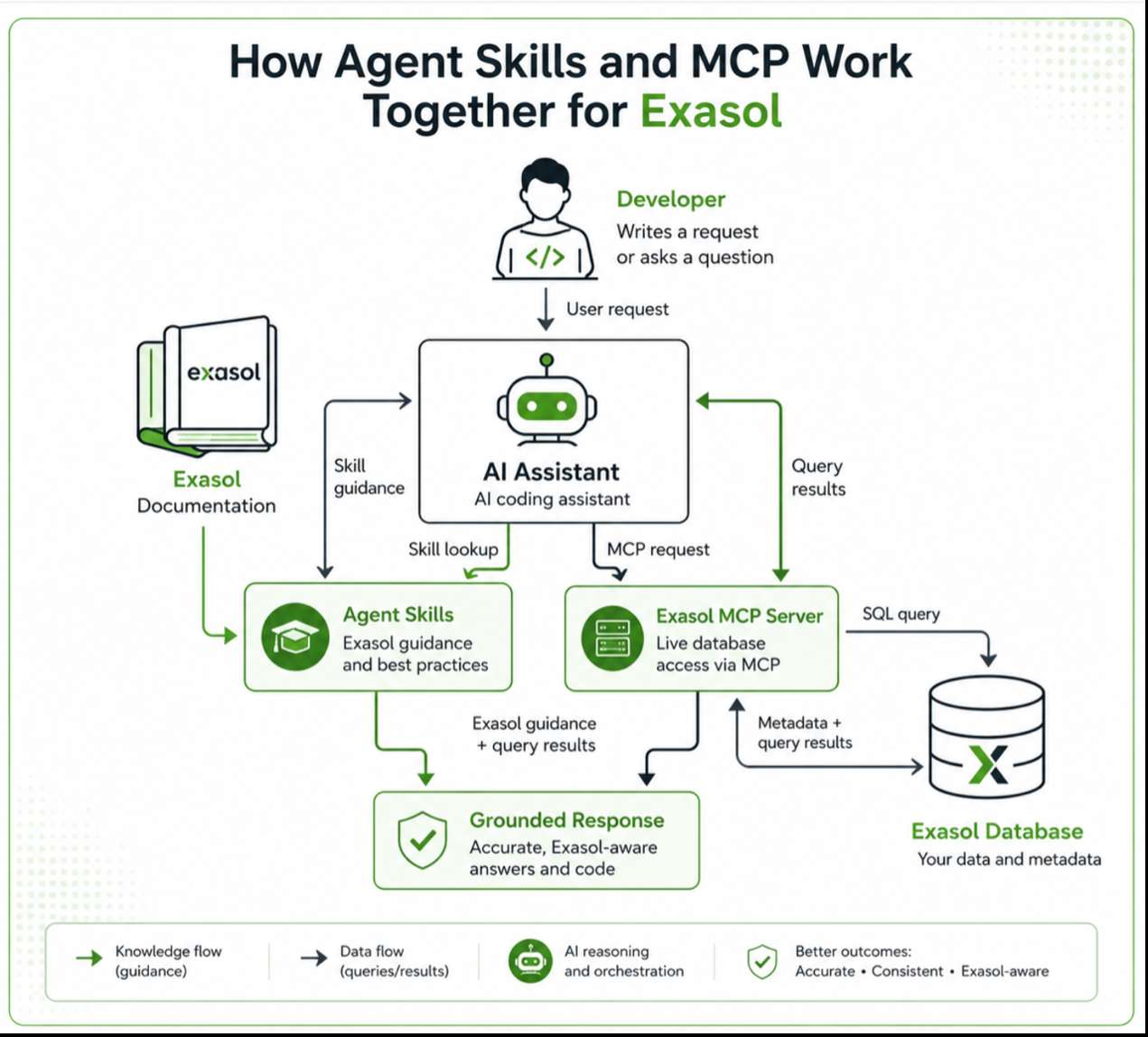
MCP enables AI assistants to connect to Exasol and interact with live databases. Through MCP, an agent can inspect schemas, retrieve metadata, execute SQL queries, and work with live database objects.
Agent skills provide the guidance that helps the assistant use those capabilities correctly.
The following diagram illustrates how Agent Skills and the Exasol MCP Server work together during a typical request.
A simple way to think about it is:
- MCP answers: What is in the database?
- Agent Skills answer: How should I work with Exasol?
One provides access.
The other provides guidance.
Together, they enable AI assistants to combine live database information with Exasol-specific guidance, producing responses that are grounded in both documented practices and the current state of the database.
Available Agent Skills
Exasol currently provides several Agent Skills, each focused on a specific area of the database.
Exasol Database
Generate Exasol-specific SQL, load data, and work with database features using documented guidance
Exasol UDF
Build Python, Java, Lua, and R User Defined Functions that follow Exasol conventions, including the use of Script Language Containers.
BucketFS
Manage files, libraries, and packages stored in BucketFS using documented workflows and conventions.
These skills are available through the open-source Exasol Agent Skills GitHub repository and follow the Agent Skills open standard. They currently support AI coding assistants such as Claude Code and OpenAI Codex, with additional assistants expected to adopt the standard over time.
Because each skill is self-contained, new capabilities can be added over time without changing the overall approach, allowing the available guidance to evolve alongside Exasol.
Why Agent Skills Matter
As agentic tools become part of the daily development workflow, developers increasingly expect assistants to do more than generate generic code.
They expect them to understand the technologies they’re working with.
By packaging Exasol-specific syntax, conventions, examples, and documentation into reusable guidance packages, Agent Skills help AI assistants generate responses that are better aligned with documented Exasol practices.
Instead of repeating the same instructions in every conversation, developers can rely on reusable guidance that is available whenever the assistant encounters a relevant task.
From Access to Expertise
Large language models already know a great deal about software development. What they don’t automatically know is how every database is designed to work.
Agent Skills bridge that gap by packaging Exasol-specific guidance into reusable skill packages that AI coding assistants can apply when needed. Combined with live database access through MCP, they help AI assistants move beyond generic database responses and work with Exasol using documented syntax, conventions, and best practices.
Connecting AI to your database is important.
Teaching it how to work with your database is what makes it useful.
Go deeper
- Build AI Agents with Exasol — understand how Agent Skills and MCP work together: https://docs.exasol.com/db/latest/ai/ai_build_agents/index.htm
- Agent Skills documentation — learn how AI assistants use reusable Exasol knowledge: https://docs.exasol.com/db/latest/ai/ai_build_agents/what-are-agent-skills.htm
- Exasol Agent Skills — browse the source code, published skills, and installation guide: https://github.com/exasol-labs/exasol-agent-skills
- Available Skills — explore the Database, UDF, and BucketFS skills: https://docs.exasol.com/db/latest/ai/ai_build_agents/available-skills-reference.htm