
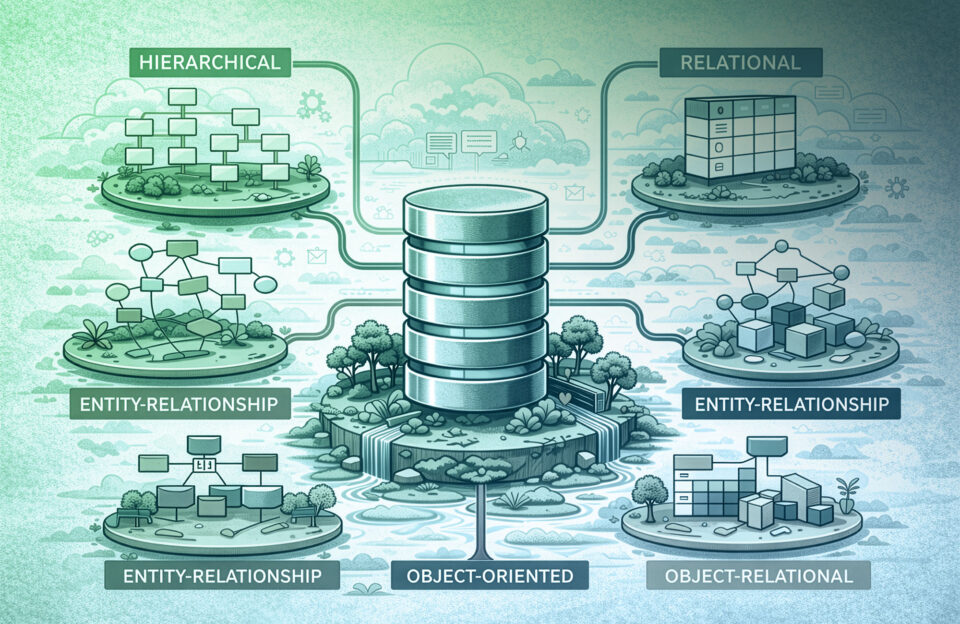
Database Models Explained: Structures, Concepts, and Core Types

A database model is a formal framework that defines how data is structured, related, and constrained inside a database system. It specifies how entities, attributes, and relationships are organized at the logical level. Database models provide structural rules for designing schemas before physical implementation.
A database model is not a database product or deployment category. It focuses on logical data structure, not on database engines, platforms, or workloads. But they do provide the structural foundation for systems such as the Exasol Analytics Engine, where logical data design directly influences query execution and analytical performance.
Core elements defined by a database model include:
- how records are structured
- how relationships are represented
- how constraints are enforced
- how data dependencies are expressed
Different models use different structural patterns, such as tables, trees, graphs, or object structures. These patterns determine how relationships are stored and how queries navigate the data.
The table below summarizes the core classical database models and their structural characteristics.
| Database Model | Structural Pattern | How Relationships Are Represented | Key Characteristic |
|---|---|---|---|
| Hierarchical | Tree | Parent–child links | Each child has one parent |
| Network | Graph | Explicit link sets between records | Records can have multiple parents |
| Relational | Tables | Primary and foreign keys | Declarative, set-based querying |
| Entity–Relationship | Diagram-based design | Entities and cardinality rules | Used for conceptual design |
| Object-Oriented | Objects and classes | Object references | Supports inheritance and encapsulation |
| Object-Relational | Tables with complex types | Keys plus structured types | Extends relational with object features |

Test Real Analytical Workloads with Exasol Personal
Unlimited data. Full analytics performance.
Database Models vs Database Types vs Schemas
The terms database model, database type, and database schema are related but not interchangeable. They describe different layers of database design and classification. Clear separation improves technical accuracy and aligns with foundational database concepts.
A database model defines the logical structure used to represent data and relationships. A database type classifies database systems by their overall architecture or storage approach. A database schema is the concrete structural definition created using a chosen model.
| Term | Scope | What It Describes | Example |
|---|---|---|---|
| Database model | Conceptual / logical | Data structure and relationship pattern | Relational model, hierarchical model |
| Database type | System category | Class of database system | Relational database, graph database |
| Database schema | Implementation | Concrete table and field design | Customer table with columns and keys |
One database type can implement a specific database model. For example, a relational database system implements the relational model. The schema then defines the exact tables, columns, keys, and constraints inside that system.
Levels of Data Modeling
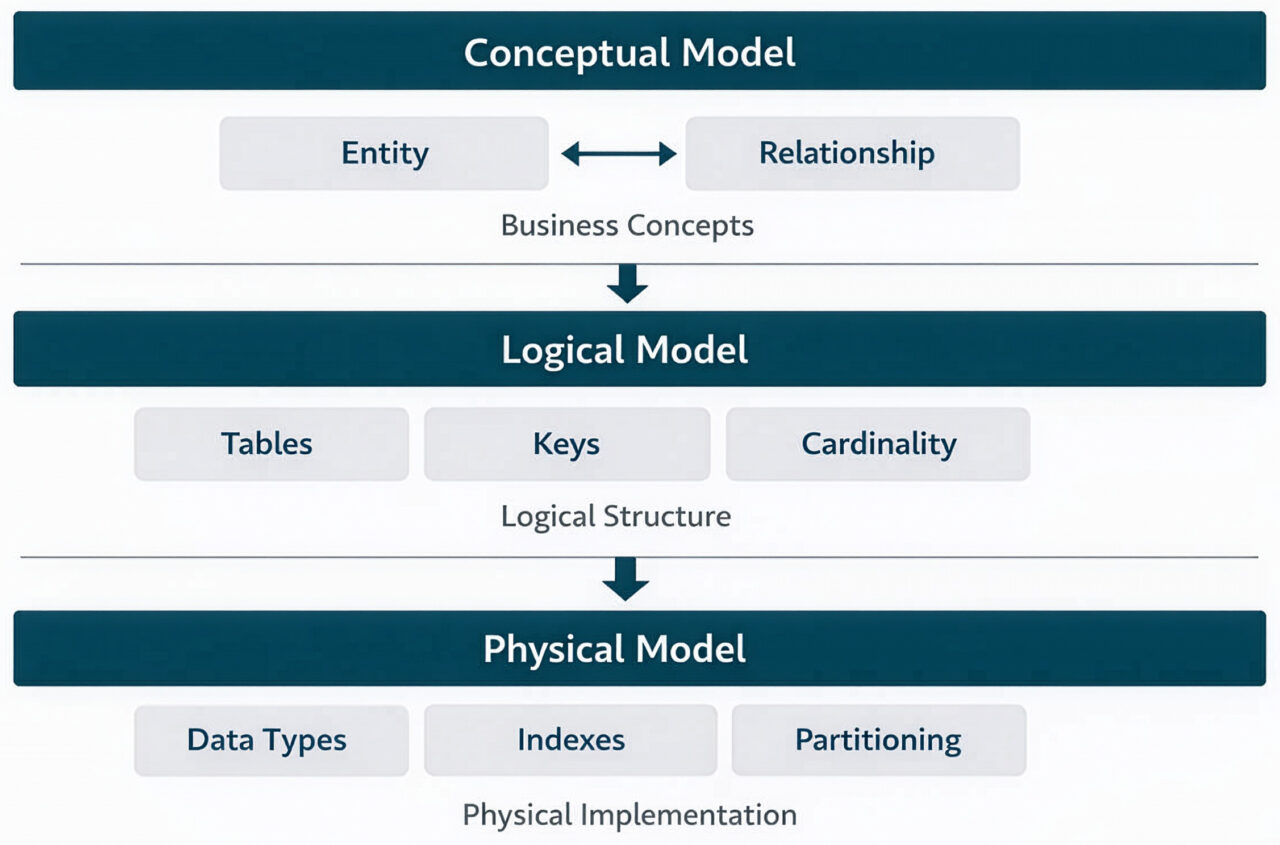
Data modeling is performed in three levels: conceptual, logical, and physical. Each level describes the same data domain with a different degree of detail and technical specificity. These levels separate business structure from implementation details and guide the database design process step by step.
The database model defines the structural rules. The modeling levels define how precisely those rules are specified during design.
Conceptual Data Model
A conceptual data model describes the high-level structure of a data domain from a business perspective. It identifies main entities and the relationships between them without defining technical attributes or storage details.
This level focuses on meaning and scope, not implementation.
A conceptual model typically defines:
- core entities
- major relationships
- business concepts
- domain boundaries
- It does not define:
- columns or data types
- primary keys
- indexes
- constraints
Conceptual models are used during requirements analysis and early system design. They align stakeholders on what data exists and how major concepts relate.
Logical Data Model
A logical data model adds structural detail to the conceptual model. It defines attributes, keys, and relationship cardinality using the rules of a chosen database model, such as the relational or object-relational model.
This level is technology-independent but structurally precise.
A logical model typically defines:
- attributes per entity
- primary and foreign keys
- relationship cardinality
- normalization structure
- integrity constraints
It does not define:
- storage engines
- index types
- partitioning
- vendor-specific features
Logical models translate business concepts into formal data structures that can be implemented in different database systems.
Physical Data Model
A physical data model specifies how the logical model is implemented in a specific database system. It includes storage and performance details tied to a chosen platform.
This level is technology-dependent.
- A physical model typically defines:
- column data types
- index structures
- partitioning rules
- storage layout
- engine-specific constraints
It converts logical structures into executable database definitions such as DDL statements.
Core Database Models
Classical database models define the main structural patterns used to organize and relate data at the logical level. Each model uses a different representation method for entities and relationships. These models shaped early database systems and still influence modern database design.
The most established database models are:
- hierarchical
- network
- relational
- entity-relationship
- object-oriented
- object-relational
Each model differs in how it represents relationships, navigates data, and enforces structure.
Test Real Analytical Workloads with Exasol Personal
Unlimited data. Full analytics performance.
Hierarchical Model
The hierarchical model organizes data in a tree structure. Each record has a single parent and can have multiple child records. Relationships follow a strict one-to-many pattern.
Data is stored as nested parent-child segments. Access paths are predefined and traversal follows the tree from root to leaves.
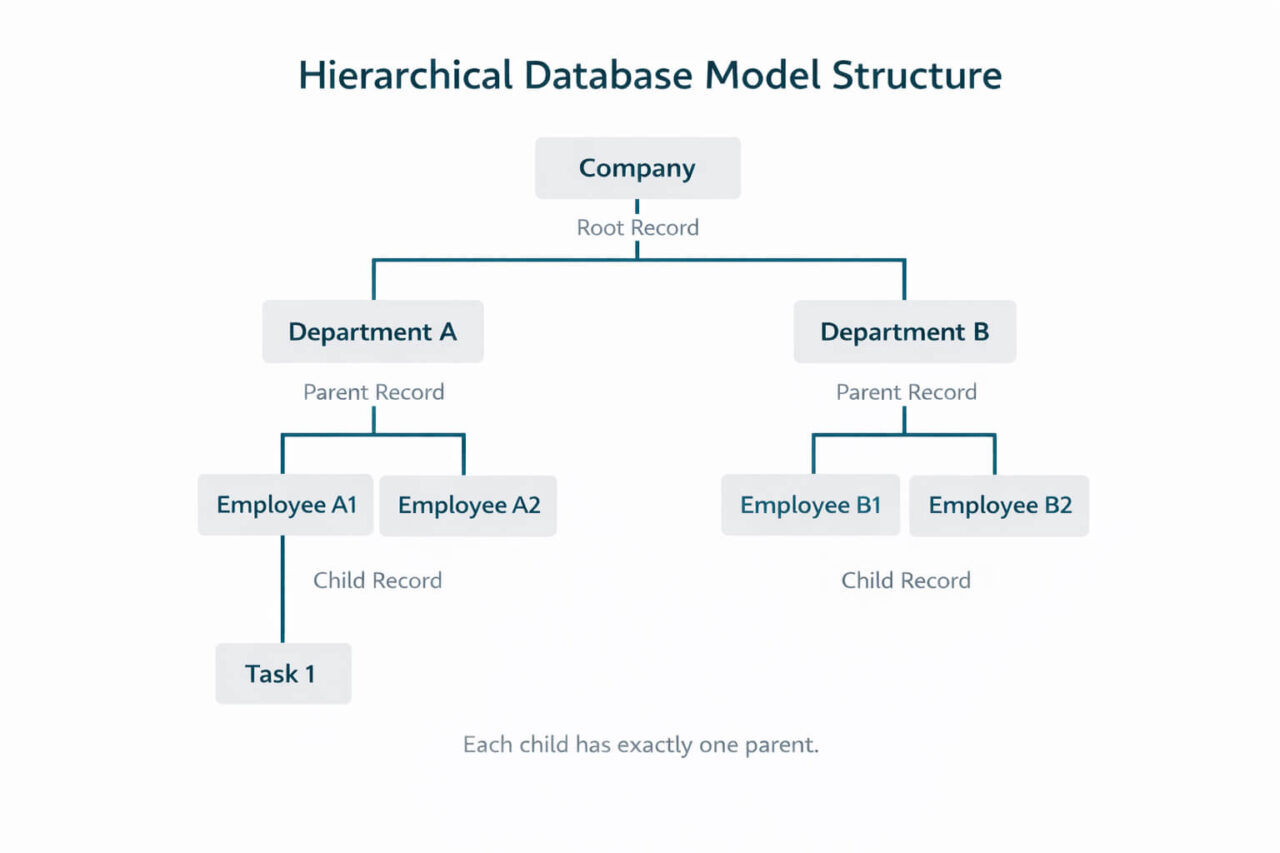
Structure characteristics:
- tree-shaped hierarchy
- single parent per child
- fixed navigation paths
- strong structural rigidity
Strengths:
- simple structure
- fast traversal along known paths
- predictable access patterns
Limitations:
- weak support for many-to-many relationships
- structural changes are difficult
- path-dependent queries
The hierarchical model appeared in early mainframe database systems and is still used in some configuration and directory structures.
Network Model
The network model extends the hierarchical model by allowing records to have multiple parents. It represents data as a graph structure rather than a strict tree.
Relationships are defined through explicit link sets between record types. A record can participate in multiple relationships simultaneously.
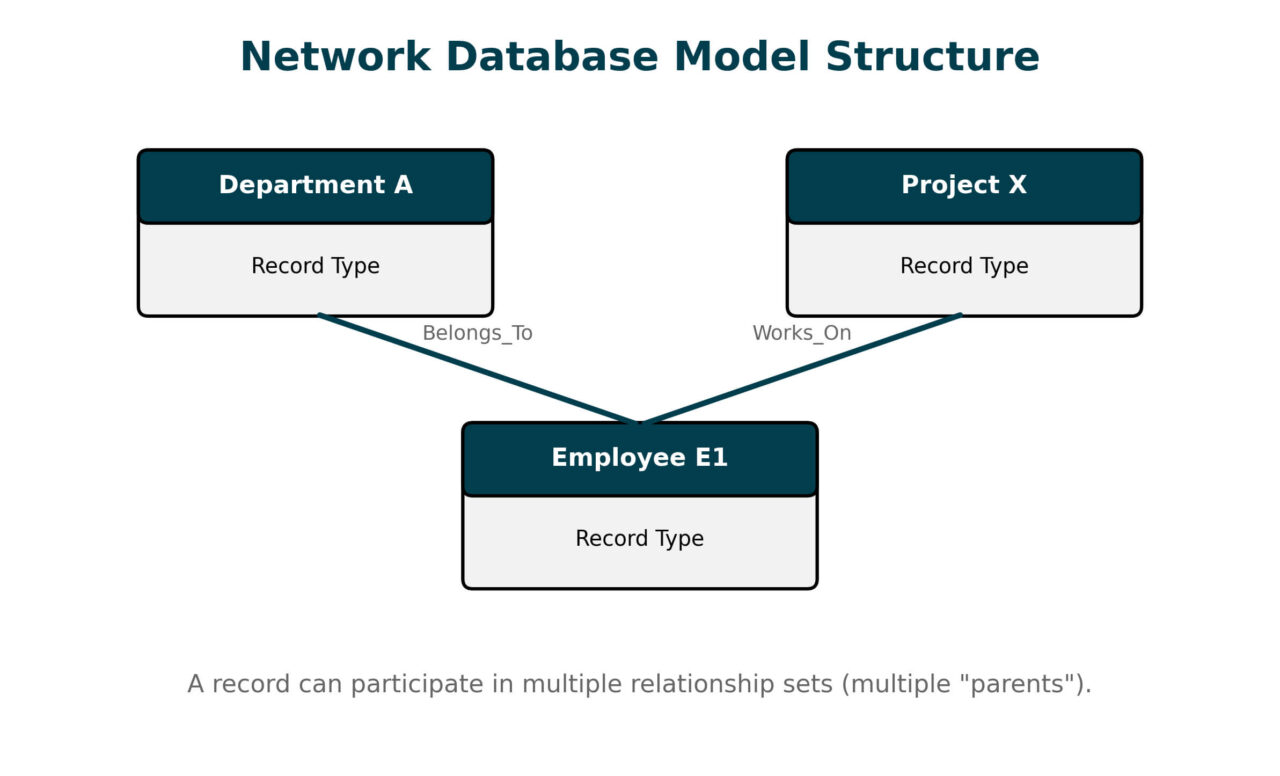
Structure characteristics:
- graph-based structure
- multiple parent relationships
- pointer-based navigation
- predefined relationship sets
Strengths:
- supports many-to-many relationships
- more flexible than hierarchical model
- efficient for complex relationship graphs
Limitations:
- complex schema design
- navigation logic is tightly coupled to structure
- difficult query formulation
The network model improved relationship flexibility but increased modeling and query complexity.
Relational Model
The relational model was first formalized in E. F. Codd’s relational model paper, which introduced the concept of representing data as sets of tuples with defined relationships.
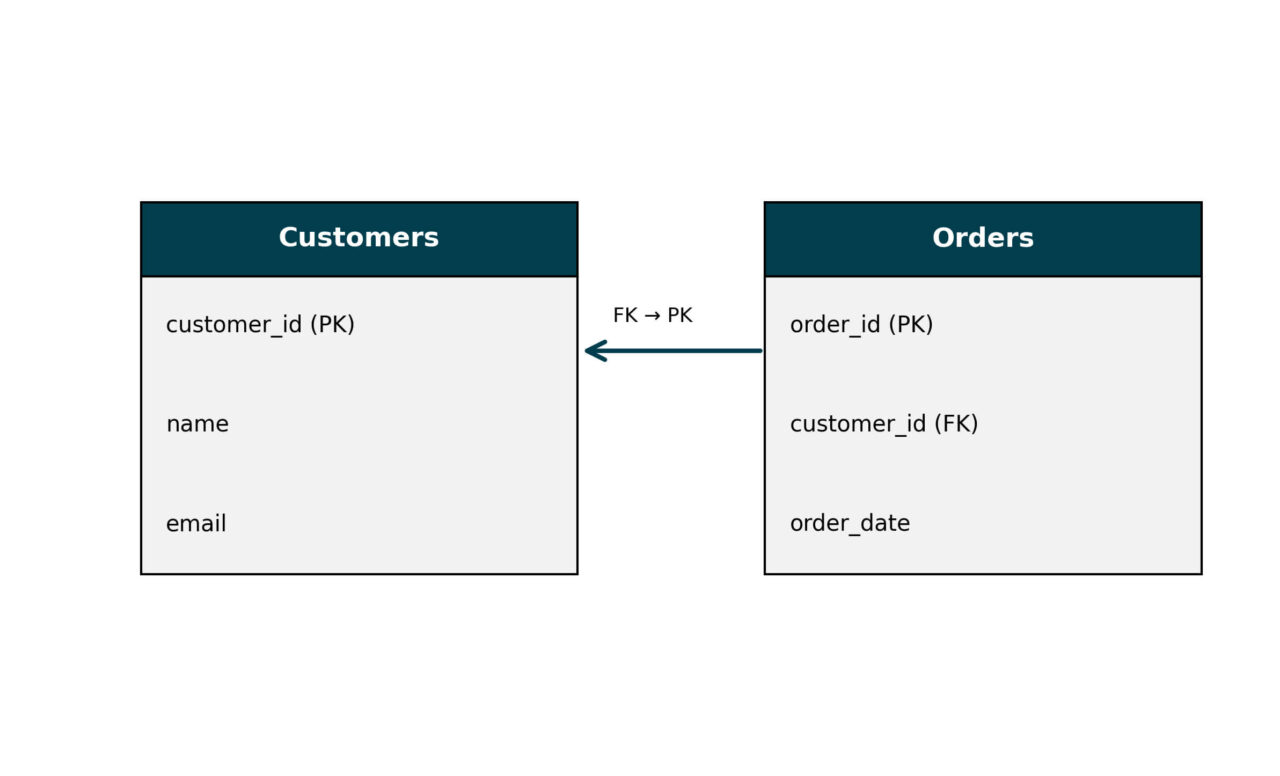
The relational model represents data as tables composed of rows and columns. Relationships are defined through keys and constraints rather than physical pointers.
Each table represents an entity or relationship. Rows represent records. Columns represent attributes. Relationships are enforced through primary and foreign keys.
Structure characteristics:
- table-based structure
- key-driven relationships
- declarative query model
- set-based operations
Strengths:
- strong mathematical foundation
- flexible query capabilities
- clear constraint enforcement
- model independence from access paths
Limitations:
- joins can be expensive at scale
- complex object structures require decomposition
- strict schema requirements
The relational model remains the dominant logical model in database design and underpins SQL-based systems.
Entity–Relationship Model
The entity–relationship (ER) model is a conceptual modeling framework used to design logical database structures. It represents data using entities, attributes, and relationships.
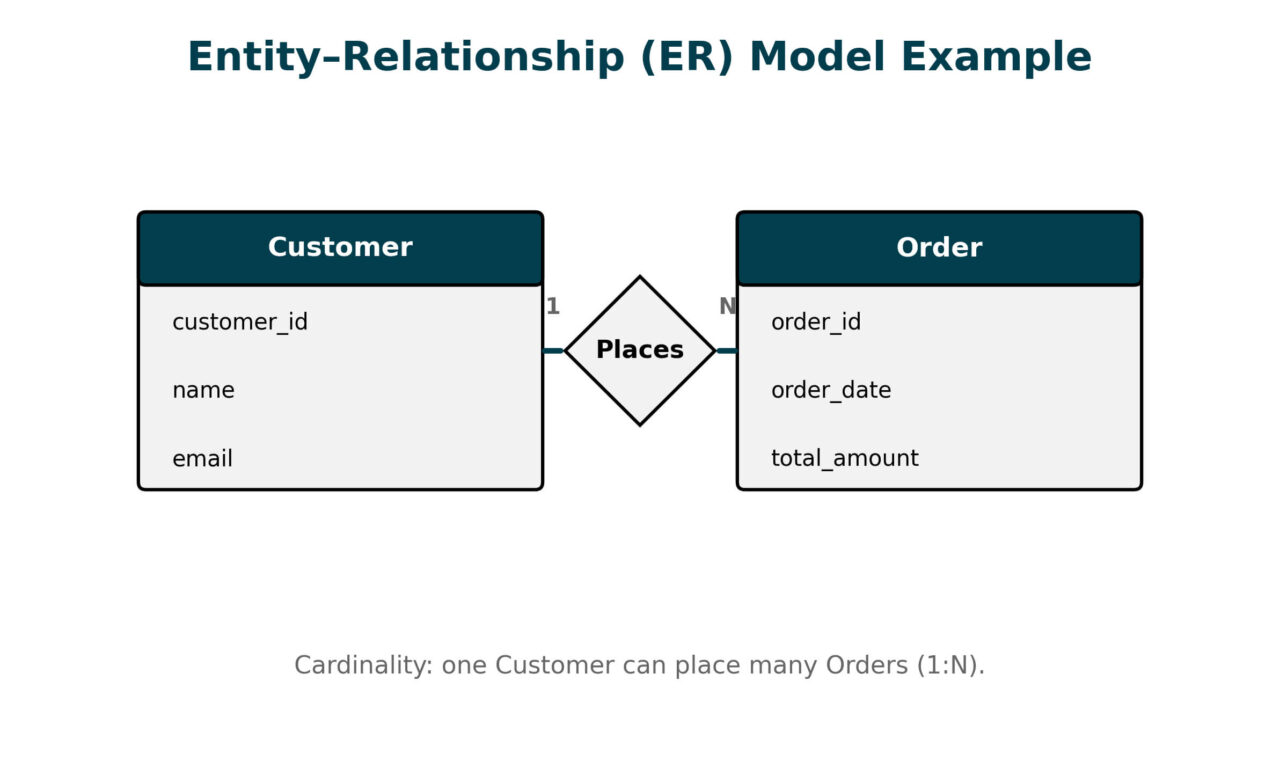
It is primarily a design model, not a storage model. ER diagrams are used to define structure before converting it into a relational or other logical schema.
Structure characteristics:
- entity types
- attribute sets
- relationship types
- cardinality rules
Strengths:
- clear visual representation
- strong design communication tool
- supports early modeling stages
- maps well to relational schemas
Limitations:
- not directly executable
- requires transformation into another logical model
- diagram complexity grows quickly
The ER model is widely used during conceptual and logical database design.
Test Real Analytical Workloads with Exasol Personal
Unlimited data. Full analytics performance.
Object-Oriented Model
The object-oriented model stores data as objects that combine attributes and behavior. Objects are grouped into classes and support inheritance and encapsulation.
Relationships are represented through object references rather than foreign keys.
Structure characteristics:
- object identity
- class hierarchies
- inheritance
- method binding
Strengths:
- natural fit for object-oriented applications
- supports complex data structures
- reduces object-relational mapping layers
Limitations:
- weaker standardization
- complex query models
- limited adoption compared to relational systems
This model is used in object database systems and specialized applications.
Object-Relational Model
The object-relational model extends the relational model with object-oriented features. It keeps table structures while adding support for complex types and inheritance.
It combines relational foundations with richer data representations.
Structure characteristics:
- relational tables
- user-defined types
- nested structures
- inheritance support
Strengths:
- compatible with relational querying
- supports complex data types
- reduces schema fragmentation
Limitations:
- increased schema complexity
- vendor-specific extensions
- portability differences
Object-relational modeling appears in advanced relational systems that support extended type systems.
How Database Models Represent Relationships
A core function of any database model is to define how relationships between data elements are represented and constrained. The structure of these relationships determines how data can be queried, navigated, and validated.
Different database models use different mechanisms to express relationships. Some rely on structural hierarchy, others on keys, pointers, or object references.
Relationship Cardinality
Cardinality defines how many instances of one entity can relate to another. It describes the quantitative constraint between entity types.
Common cardinality patterns include:
- one-to-one (1:1)
- one-to-many (1:N)
- many-to-many (M:N)
In the relational model, cardinality is enforced using primary and foreign keys. In hierarchical models, cardinality is implied by the tree structure. In network models, explicit relationship sets define cardinality.
Clear cardinality definition prevents ambiguity in data interpretation and enforces structural consistency.
Keys and Identifiers
Keys uniquely identify records and establish relationships between them. They are central in relational and object-relational models.
Key types include:
- primary keys
- foreign keys
- candidate keys
- composite keys
A primary key uniquely identifies a record within a table. A foreign key references a primary key in another table to establish a relationship.
In pointer-based models such as hierarchical and network models, relationships are navigated through predefined structural links rather than foreign key constraints.
Referential Integrity
Referential integrity ensures that relationships remain valid over time. It prevents orphaned records and inconsistent references.
In relational systems, referential integrity is enforced through foreign key constraints. In hierarchical models, parent-child structure inherently restricts invalid references. In network models, relationship sets define allowed link structures.
Referential integrity supports consistency and predictability in query results.
Normalization and Dependency Control
Normalization organizes relational structures to reduce redundancy and eliminate undesirable data dependencies. It relies on formal rules derived from the relational model.
Normalization addresses:
- update anomalies
- insertion anomalies
- deletion anomalies
- functional dependencies
Other database models manage redundancy differently. Hierarchical and network models embed relationships structurally. Object-oriented models encapsulate data within object boundaries.
Normalization improves structural clarity and reduces data inconsistency in relational schemas.
Navigation vs Declarative Access
Database models also differ in how relationships are accessed.
Hierarchical and network models use navigational access. Queries follow predefined structural paths.
The relational model uses declarative access. Queries specify conditions and allow the system to determine execution strategy.
This distinction affects flexibility, abstraction level, and schema evolution.
Strengths and Limitations of Major Database Models
Each database model defines a different structural approach to organizing data. These structural choices influence flexibility, query behavior, schema evolution, and relationship handling.
The comparison below evaluates core structural characteristics. It does not evaluate specific database products.
| Model | Structural Pattern | Relationship Handling | Schema Flexibility | Query Approach |
|---|---|---|---|---|
| Hierarchical | Tree | Parent-child links | Low | Navigational |
| Network | Graph with link sets | Explicit pointer relationships | Moderate | Navigational |
| Relational | Tables | Foreign keys and joins | High (with constraints) | Declarative |
| Entity–Relationship | Diagram-based design | Modeled via cardinality | High at design stage | Not executable |
| Object-Oriented | Objects and classes | Object references | High within object hierarchy | Object-based |
| Object-Relational | Tables with complex types | Keys plus structured types | Moderate–High | Declarative |
Flexibility
The relational model separates logical structure from physical access paths. This increases flexibility when schemas evolve. The network and hierarchical models tie structure closely to navigation paths, which reduces adaptability.
Object-oriented models allow nested and complex structures but may reduce interoperability across systems.
Relationship Complexity
The hierarchical model restricts each child to one parent. The network model supports multiple parent relationships but requires explicit link definitions.
The relational model supports many-to-many relationships using associative tables. The ER model formalizes relationship types before schema implementation.
Schema Evolution
Relational schemas can evolve through controlled constraint changes and normalization adjustments. Hierarchical and network schemas are more rigid because structural relationships are embedded in navigation paths.
Object-relational extensions introduce additional complexity when altering type hierarchies.
Query Abstraction
Navigational models require predefined traversal paths. Queries depend on structural design.
The relational model abstracts traversal logic through declarative queries. The user specifies conditions rather than navigation order.
This separation increases logical independence from physical storage decisions.
Test Real Analytical Workloads with Exasol Personal
Unlimited data. Full analytics performance.
Database Models in the Database Design Process
Database models guide the structure of data throughout the design lifecycle. They provide the formal rules used to transform business requirements into logical and physical data structures. Extensive research on database modeling and theory is documented in academic repositories such as the DBLP computer science bibliography.
The database design process typically follows a staged progression from abstract representation to executable schema.
Requirements Analysis
Design begins with identifying business entities, relationships, and constraints. At this stage, no specific database model is implemented. The goal is to define:
- core data objects
- relationship rules
- integrity requirements
- data lifecycle constraints
The output is domain understanding rather than technical schema design.
Conceptual Modeling
The conceptual data model translates requirements into structured entity and relationship representations. The entity–relationship model is commonly used at this stage.
Conceptual modeling defines:
- entity types
- relationship types
- cardinality
- participation constraints
It establishes structural clarity without committing to a specific database system.
Logical Modeling
Logical modeling applies a chosen database model, such as the relational or object-relational model. Entities and relationships are mapped into formal structures that follow model-specific rules.
Logical modeling defines:
- attributes
- keys
- normalization rules
- relationship implementation strategy
At this stage, the database model determines how relationships are expressed and constrained.
Physical Design
Physical design converts the logical model into executable definitions. It incorporates implementation details specific to a database system.
Physical design defines:
- column data types
- indexing strategy
- storage allocation
- partitioning
- constraint enforcement mechanisms
Although implementation details vary, the structural logic remains derived from the selected database model.
Model Influence Across Stages
The selected database model affects:
- how relationships are represented
- how constraints are enforced
- how queries are formulated
- how schemas evolve over time
A clear separation between conceptual, logical, and physical modeling maintains structural consistency and reduces redesign effort.
Common Misconceptions About Database Models
Database models are often confused with database systems, schemas, or storage technologies. These misunderstandings blur the distinction between logical structure and system implementation.
Clarifying these differences improves precision in database design and system selection.
Misconception 1: A Database Model Is a Database Product
A database model is not a software system or database engine. It defines the logical structure used to organize and relate data.
A relational database system implements the relational model. The model defines tables, keys, and constraints. The system executes queries and manages storage.
Model = structural rules.
System = implementation of those rules.
Misconception 2: Relational Database Means Relational Model Only
The relational model is a logical framework based on tables and key constraints. A relational database system implements that framework.
Some systems extend the relational model with object features or specialized storage optimizations. The logical model remains relational even when physical behavior differs.
Misconception 3: Schema and Model Are the Same
A database model defines structural principles. A schema applies those principles to a specific domain.
For example:
- The relational model defines tables and keys.
- A customer schema defines specific tables such as Customers, Orders, and Products.
The schema is an instance of the model.
Misconception 4: Modern Databases Do Not Use Classical Models
Modern systems still rely on foundational modeling principles. Even document and graph databases define structured patterns for representing entities and relationships.
Classical models such as relational, hierarchical, and network models established the structural logic that modern systems refine or extend.
Misconception 5: Database Models Define Performance
A database model defines logical structure, not performance behavior. Performance depends on:
- indexing strategy
- query planning
- storage engine
- hardware resources
The model influences query formulation and constraint enforcement but does not directly determine execution speed.
Test Real Analytical Workloads with Exasol Personal
Unlimited data. Full analytics performance.
Misconception 6: One Model Fits All Data
Each database model enforces structural constraints. Some support flexible schemas, others enforce strict structure. Selecting a model depends on how relationships and dependencies must be represented.
No single database model is universally optimal for all data domains.
The four commonly cited database models are the hierarchical model, network model, relational model, and object-oriented model. These models define how data is structured and how relationships are represented at the logical level. Each model uses a different structural pattern, such as trees, graphs, or tables.
A database model is a formal framework that defines how data is organized, related, and constrained within a database. It specifies the logical structure used to represent entities, attributes, and relationships before physical implementation in a database system.
SQL is not a database model. SQL is a query language used to interact with databases. It is most commonly associated with the relational model, which defines tables, keys, and constraints. The relational model defines structure; SQL provides the syntax to query and manipulate that structure.
The three classical structured database models are the hierarchical model, the network model, and the relational model. These models were developed to formalize how structured data and relationships are represented in database systems. Each model uses a different structural approach to organizing records.