
Customer Story


DKMS
Discover how DKMS uses Exasol to unify data across seven countries, standardize KPIs, and reduce international reporting from lengthy manual processes to seconds.

How DKMS standardizes KPIs and delivers reporting in seconds with Exasol
Case Study

DKMS is an international nonprofit that helps give blood cancer patients a second chance at life through stem cell donation. Since its founding in Germany in 1991, DKMS has registered more than 13.5 million potential donors and facilitated more than 140,000 stem cell donations. DKMS operates in Germany, the United States, Poland, the United Kingdom, Chile, India, and South Africa.
To give medical and non-medical departments access to company-wide KPIs that are consistently defined and quality-checked, DKMS uses Exasol as its on-premises data warehouse. The solution was implemented with partner areto. The data warehouse processes data from 11 systems and supports international analysis, standard and ad hoc reporting, and campaign audience selection.
Previously, international reporting required seven separate country queries and manual consolidation of the results. Each query could take up to 30 minutes. With Exasol the entire process takes only a few seconds, while KPIs are provided more consistently across the organization.
Germany
1600
Healthcare
DWH powered by the Exasol Database

The Challenge
Medical and non-medical departments rely on timely, reliable reporting based on consistently defined KPIs. The legacy reporting environment no longer met DKMS’s requirements for data content and performance. This created several reporting challenges:
The differences in KPIs resulted from different definitions and calculation logic, making it necessary for DKMS to have a reporting environment that could combine data from multiple sources, standardize KPIs across the organization, and give departments faster access to consistent reporting data. During the project, these definitions were aligned and standardized internationally.

DKMS was looking for an analytical database that could meet both its reporting requirements and its approach to protecting sensitive core data.
DKMS chose Exasol based on the following requirements:
areto recommended Exasol’s Data Warehouse Automation and designed, built, installed, and implemented the solution in close collaboration with DKMS’s infrastructure and project teams.
DKMS organizes its central reporting environment into three layers: source systems, data storage, and reporting.
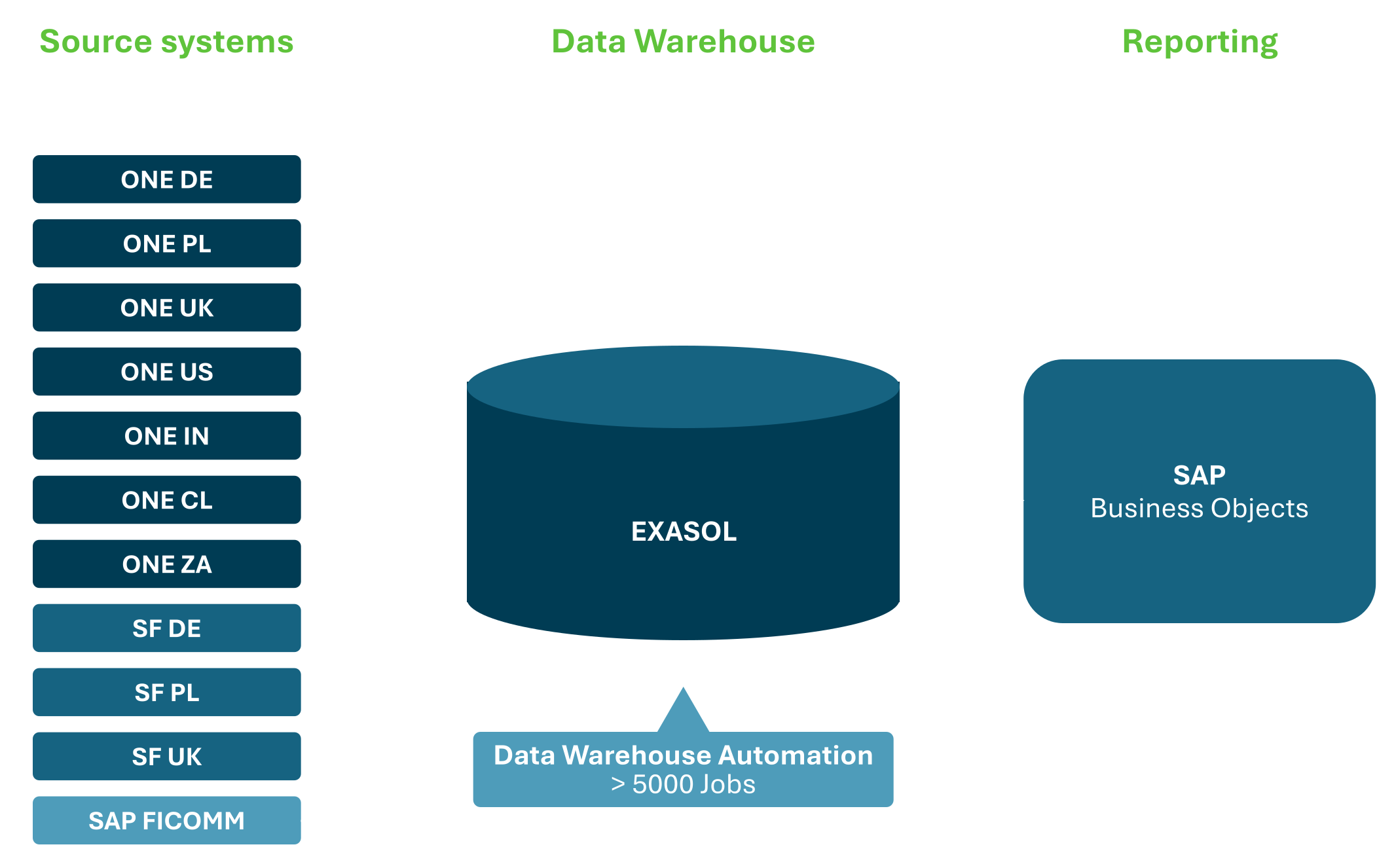
The Solution
DKMS uses Exasol as its data warehouse for reporting modernization. The solution was built from scratch as a greenfield project. Data Warehouse Automation supports daily data processing.

The Exasol environment includes:
With the new architecture, DKMS can use Salesforce and SAP data in one reporting environment for the first time. This supports faster standard reports, more flexible ad hoc reports, and campaign audience selection.

Results
For DKMS, the most important measurable result is the time saved in international reporting.
The time and manual effort required for cross-country reporting have been significantly reduced.
Around 200 employees across all business departments access the database through SAP Business Objects.
Historical data can be processed efficiently, opening new possibilities for analytics and forecasting.
Standardized definitions and less manual consolidation reduce the risk of differing interpretations and manual errors.
The rebuild exposed issues in source systems, so DKMS could correct them at the source.
Company-wide KPIs are standardized and checked for quality.
The platform supports DKMS as data from existing and new sources grows non-linearly.
Departments can analyze data as of a defined reporting date.
DKMS expects capacity requirements to grow over the next five years, driven by organic growth across the countries where DKMS operates and connections to additional systems, including SAP HCM. Because DKMS processes data with strict protection requirements, core data will remain on-premises.
The platform also creates a foundation for future AI-assisted analysis and data-driven processes, where data quality and speed are becoming increasingly important.
Exasol supports this strategy with faster query performance, scalability, and on-premises deployment.
Customer Stories


