
Shift Left – Simplifying Medallion Pipelines to Accelerate Analytics at Scale

Abstract
Medallion architectures promise organised, layered data flow from Bronze through Silver to Gold. In practice, most enterprises end up with convoluted pipelines featuring 150+ interdependent DAGs (Directed Acyclic Graphs — mathematical structures of one-way task dependencies that cannot loop back on themselves), duplicate transformations, and six-week delivery cycles that stifle innovation and inflate compute costs to $250 K per month or more. Sixty percent of engineering capacity is consumed by maintenance rather than value creation.
Shift Left addresses this directly by moving validation, enrichment, and governance upstream to the data source. Messaging-based refined streams arrive at Exasol already 50 % analytics-ready, eliminating downstream complexity while enforcing compliance through Schema Registry contracts from day one. This blog demonstrates how a chaotic Databricks Medallion pipeline can be transformed into an elegant, stream-first architecture powered by Exasol’s in-memory MPP engine — delivering sub-second query performance and 100+ concurrent user support. One mid-market enterprise slashed DAG count by 60 %, accelerated BI delivery by 72 %, and cut compute costs by 52 %, freeing engineers for high-value AI/ML work. Read on for actionable patterns to refactor your own pipelines and unlock Exasol’s full acceleration potential.
The Medallion Promise — and Why It Breaks
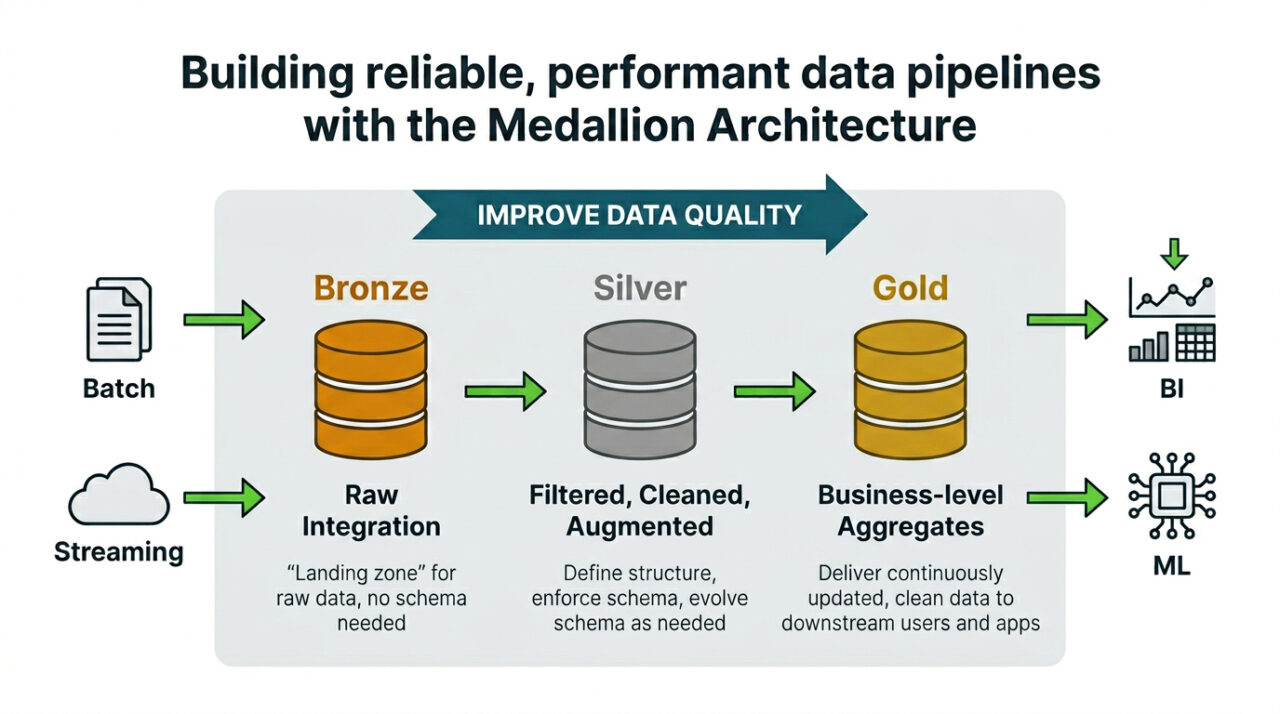
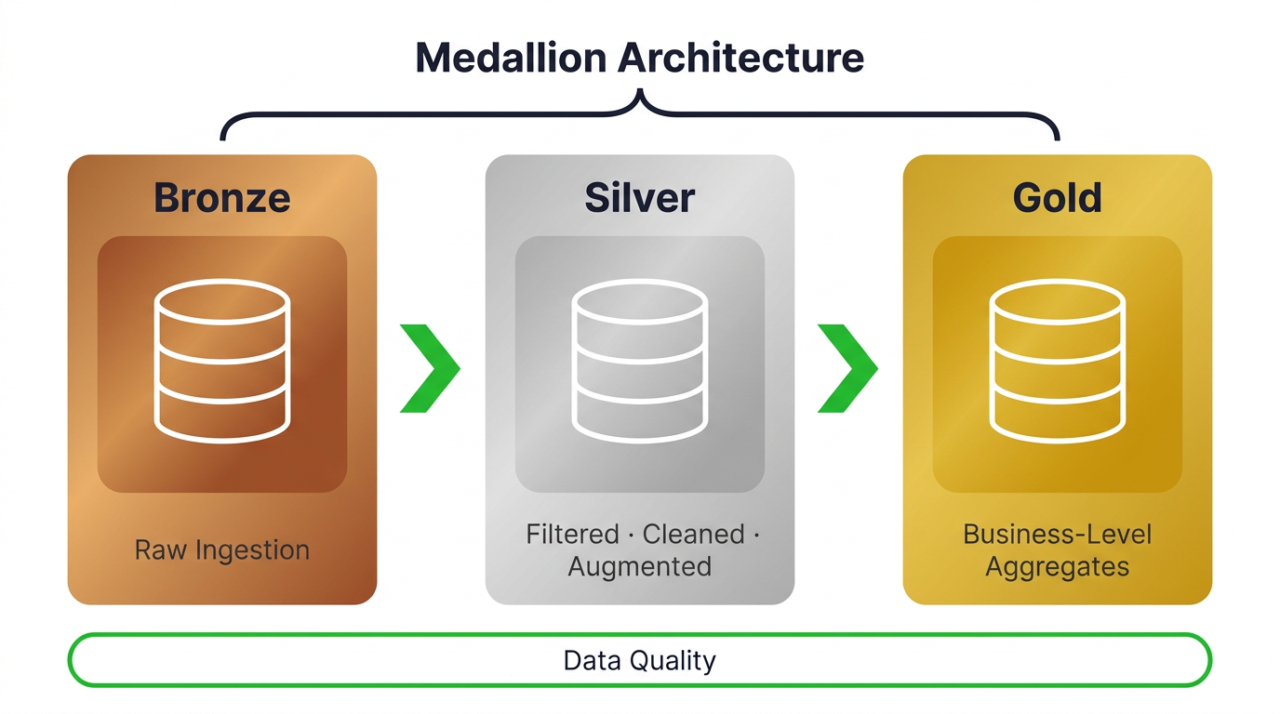
When Databricks popularised the Bronze → Silver → Gold architecture, the pitch was seductive: a clean, layered data lake in which raw data lands in Bronze, is filtered and enriched in Silver, and emerges as curated business aggregates in Gold. Simple to explain; powerful in theory.
Reality rarely matches the diagram. As organisations scale, the Medallion pattern silently accumulates technical debt until the architecture that was meant to simplify becomes the biggest obstacle to delivery.
What Goes Wrong
- 150+ interdependent DAGs: Every new use case spawns another Airflow or Spark job. Teams rarely retire old ones. The dependency graph becomes impossible to reason about.
- Duplicate transformations: Finance, Marketing, and Analytics each build their own Silver-layer logic for the same source tables. Three versions of ‘truth’ emerge in Gold.
- 6-week delivery cycles: A single upstream schema change cascades through dozens of downstream jobs. New BI requests queue behind a backlog of broken pipelines.
- $250 K+ monthly compute costs: Reprocessing the same raw data through multiple sequential jobs at every layer multiplies compute spend without multiplying business value.
- 60 % of engineering time on maintenance: Senior data engineers spend the majority of their week keeping existing pipelines alive rather than building anything new.
The Convoluted Medallion Anti-Pattern in Detail
Three symptoms reliably signal that a Medallion architecture has crossed from healthy to convoluted. Recognising them early is the first step toward remediation.
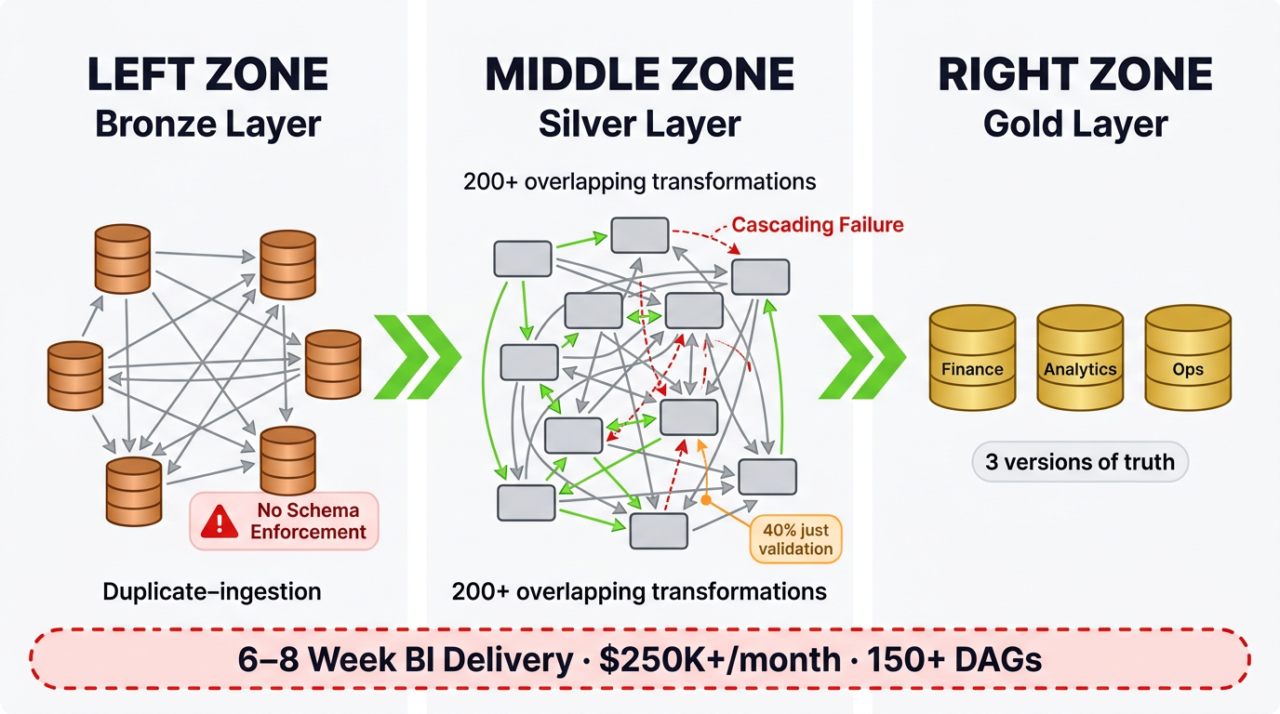
Bronze Layer Chaos
- 50+ raw tables ingested from multiple heterogeneous sources
- Duplicate ingestion pipelines built for different team use cases
- No schema enforcement at source — data contracts are assumed, not enforced
- Data quality defects introduced here propagate silently through every downstream layer
Silver Layer Junkyard
- 200+ transformation steps with unclear ownership and no deprecation policy
- Overlapping logic: Finance, Marketing, and Analytics all transform the same source data differently
- 40 % of Silver jobs exist purely to perform data quality checks — work that should have been done at source
- Cascading failures: a single upstream schema change breaks dozens of downstream jobs simultaneously
Gold Layer Complexity
- Three competing versions of ‘truth’: Finance Gold, Analytics Gold, Operations Gold
- Business agility is blocked by long upstream dependency chains
- New BI requests take 6–8 weeks to reach production
The root cause is not the Medallion concept itself — it is the absence of upstream data contracts and stream-first thinking. Data arrives dirty and schema-free, forcing every downstream layer to compensate. Shift Left removes the root cause rather than treating the symptoms.
The Shift Left Revolution
Shift Left is a deceptively simple idea: move validation, enrichment, masking, and governance as far upstream as possible — ideally to the moment data leaves its source system. Consumers downstream then receive data that is already largely analytics-ready, without needing to repeat quality checks at every layer.
From Old Way to Shift Left
Old Way — Validate in Silver / Gold
- Quality checks duplicated at Bronze, Silver, Gold
- Each team re-validates the same data
- Errors discovered late, expensive to fix
- 5× compute overhead from repeated processing
Shift Left — Validate at Source
- Schema Registry enforces contracts at event production
- Flink applies enrichment, masking, standardisation in-stream
- Data arrives at Exasol 50–80 % analytics-ready
- Single validation pass; downstream layers simplify dramatically
Key Benefits
- Refined Streams: Data arrives at Exasol already 50–80 % analytics-ready, with Exasol UDFs handling final curation at ingest.
- Single Validation: Quality gates applied once at source, not five times across layers.
- Compliance Built-In: Schema Registry enforces contracts from day one — GDPR masking and PII removal happen before data enters the pipeline.
- Downstream Simplicity: Exasol and BI tools are freed from transformation overhead; they can focus entirely on serving queries.
- Real-Time + Batch: Both operational and analytical consumers are served from the same high-quality, low-latency stream.

Shift Left Architecture with Exasol
The reference architecture below shows how four layers work together to deliver a analytics-first accelerated data platform.
| Layer | Technology | Function |
|---|---|---|
| 🏢 SOURCE SYSTEMS | CRM · ERP · Logs · Events · IoT | Any change-data-capture or event-producing system. Data leaves the source immediately as a stream. |
| 🔄 SHIFT LEFT LAYER | Apache Kafka + Apache Flink + Schema Registry | Validation · Enrichment · Masking · Standardisation → Refined Streams (50–80 % analytics-ready) |
| ⚡ EXASOL ACCELERATION | In-Memory MPP analytics database | UDF-based final curation at ingest · Sub-second queries · 100+ concurrent users · Self-optimising · No manual tuning |
| 📊 BI & ANALYTICS | Dashboards · Reports · ML Features · Real-Time Apps | Powered by Exasol’s sub-second response. Engineers focus on insights, not pipeline maintenance. |
Five Core Shift Left Principles
- Stream-First, Not Storage-First
Apache Kafka, Kinesis (or equivalent) becomes the data spine of your platform. Events flow continuously; storage in Delta Lake or S3 is a byproduct, not the primary transport mechanism. - Schema & Governance from the Start
Schema Registry enforces data contracts at the producer. Data arrives pre-validated. The ‘fix it later’ mentality is replaced by a ‘right first time’ contract culture. - Early Enrichment
Reference data joins, business entity resolution, and initial business logic are applied in Flink stream processors before data reaches Exasol. Exasol receives enriched, join-ready data. - Partitioned Responsibility
Each team owns exactly one stream topic and is accountable for its quality. Downstream consumers trust the stream; they do not re-validate or re-transform. Duplication disappears. - Best-of-Breed Technology Blend
Kafka/Flink for streaming. Delta Lake / S3 for cost-effective archival storage. Exasol as the high-performance analytics acceleration tier. Every component does what it does best.
Transformation Potential Composite Scenario
Following scenario is a composite representation of patterns observed across enterprise data modernisation engagements. All figures are directional based on publicly available benchmarks, no specific customer referenced.
Starting Point: The Convoluted Pipeline
- 2 PB historian data lake; 5 TB new streaming data arriving daily
- Amazon Kinesis ingesting raw orders, customer events, inventory updates
- Bronze: orders_raw, customers_raw, inventory_raw — schema-free landing zone
- Convoluted Silver: 40+ Spark jobs with overlapping, poorly-owned transformations
- Gold: three competing aggregation layers (finance-gold, analytics-gold, ops-gold)
- 150+ DAG dependencies; 6-week feature delivery velocity
- Representative query execution time: 8.5 seconds on a Gold aggregation table
The Shift Left Transformation
Step 1 — Refined Stream
- Schema validated via Schema Registry — data contracts enforced at producer
- Enriched with dimension attributes (product hierarchy, customer segment) in Flink
- Timestamps and decimal precision standardised to agreed data contract
- PII (Personally Identifiable Information) masked at source before data enters persistent store
Result: data arrives at Exasol already 50+% analytics-ready
Step 2 — Ingest to Exasol
- Exasol consumes the refined stream via CDC (Change Data Capture)
- Materialized view orders_daily_revenue built automatically
- Auto-indexed, statistics computed, columnar compression applied — zero DBA effort
- Exasol UDFs handle the final 20–50 % curation at ingest time
Result: same query executes in 120 milliseconds — 70× faster !

Quantified Business Impact
| Metric | Before (Convoluted Medallion) | After (Shift Left + Exasol) |
|---|---|---|
| Pipeline DAGs | 150+ DAGs / 40+ UDF libraries | 60 DAGs → 60 % reduction |
| Engineering FTEs | 12 FTEs on maintenance | 8 FTEs (4 freed for AI/ML) |
| BI Delivery Time | 6–8 weeks per project | 2–3 weeks → 72 % faster |
| Data Quality Issues | 1 per business day | 1 per week → 85 % improvement |
| Monthly Compute | $250 K / month | $120 K / month → 52 % savings |
| Concurrent Users | 40 max (severe slowdown) | 200+ users (sub-second response) |
Why and How Exasol Powers Shift Left
Exasol is not just a beneficiary of Shift Left — it is a critical enabler. Four capabilities make it the natural analytics acceleration tier in a stream-first architecture.
🚀 In-Memory MPP Architecture
- 100+ concurrent analytics queries without performance degradation
- Sub-second response times on refined-stream data arriving via CDC
- Linear scalability — add nodes to add query capacity
- No cluster warm-up delays: data is always hot in memory
🎯 Self-Tuning Intelligence
- No manual indexing, partitioning, or statistics management
- Automatic compression and query optimisation
- Zero DBA overhead — freed capacity goes to engineering value
- Consistent performance regardless of query shape or cardinality
⚡ Performance at Scale
- Refined stream data is queryable the instant it lands
- No batch reprocessing windows; real-time and historical queries unified
- TPC-H benchmark leader since 2008 — independently verified performance
- 20–50× faster than Databricks SQL on equivalent analytical workloads
🤖 AI/ML Workload Acceleration
- ML feature engineering 50× faster on pre-refined, trusted data
- Training data preparation on streams eliminates pre-processing pipelines
- AI/ML workloads always run on governed, compliant data
- Data science teams get trusted features without waiting for pipeline teams
Exasol Lakehouse Turbo
For teams running Databricks as their system of record (Delta Lake), Exasol Lakehouse Turbo automatically caches hot tables via CDC — no manual ETL required. Databricks continues to serve as the ETL and ML platform; Exasol becomes the high-concurrency OLAP serving layer. This means existing Databricks investments are preserved while query performance improves dramatically for BI and operational analytics workloads.
Your 12-Week Shift Left Implementation Roadmap
Phase 1: Assess & Map (Weeks 1–2)
- Identify your ‘golden paths’: apply 80/20 analysis to find the 20 % of pipelines delivering 80 % of business value
- Map all complexity that adds no downstream value — focus on Silver-layer duplication
- Identify upstream data owners for each source domain (CRM team, ERP team, event producers)
- Challenge each existing pipeline: ‘If we built this today from scratch, would we build it the same way?’
Phase 2: Pilot Refined Stream (Weeks 3–4)
- Deploy a lightweight stream processor (Apache Flink or Kafka Streams) on a single high-value domain
- Apply the four Shift Left transformations: schema validation, reference-data enrichment, PII masking, standardisation
- Publish a refined Kafka topic at ‘Silver+’ quality — a single source of truth for that domain
- Validate with one concrete BI use case: measure quality, latency, and downstream query performance
Phase 3: Exasol Integration (Weeks 5–6)
- Stream the refined topic into Exasol SaaS via the Kafka Connector or CDC
- Configure incremental updates; create materialized views for your top 5 most expensive queries
- Benchmark: run identical queries against your existing Databricks SQL layer and against Exasol
- Quantify the performance delta; build the business case for full rollout
Phase 4: Scale & Optimise (Weeks 7–12)
- Expand refined streams to additional source domains and use cases
- Flatten the Gold layer: replace complex multi-hop aggregations with simple Exasol semantic views
- Decommission redundant Silver transformations as Exasol materialized views take over
- Measure and report: DAG count reduction, BI delivery cycle time, compute cost delta
Ready to Simplify Your Medallion Architecture?
Shift Left is not a rip-and-replace. It is a pragmatic, incremental modernisation pattern that delivers measurable results in weeks, not years. You keep your existing investments in Databricks, Snowflake, or Kafka, Kinesis, etc. — and you add Exasol as the acceleration layer that unlocks their full potential.
Shift Left Pilot Programme
- Bring your top 3 most convoluted DAG dependencies
- Exasol designs a Shift Left blueprint on your own data — no synthetic demos
- Pilot approach with quantified performance and cost comparison
- Zero infrastructure investment required to start
- Exasol SaaS or Exasol Personal — two ways to begin your Exasol Shift-Left trial already today